May 4, 2026 • Dale Merrick • 9 min reading time • Prices verified June 5, 2026
Ultrasonic Fuel Injector Cleaner Machines: Spec Literacy for Independent Shop Buyers
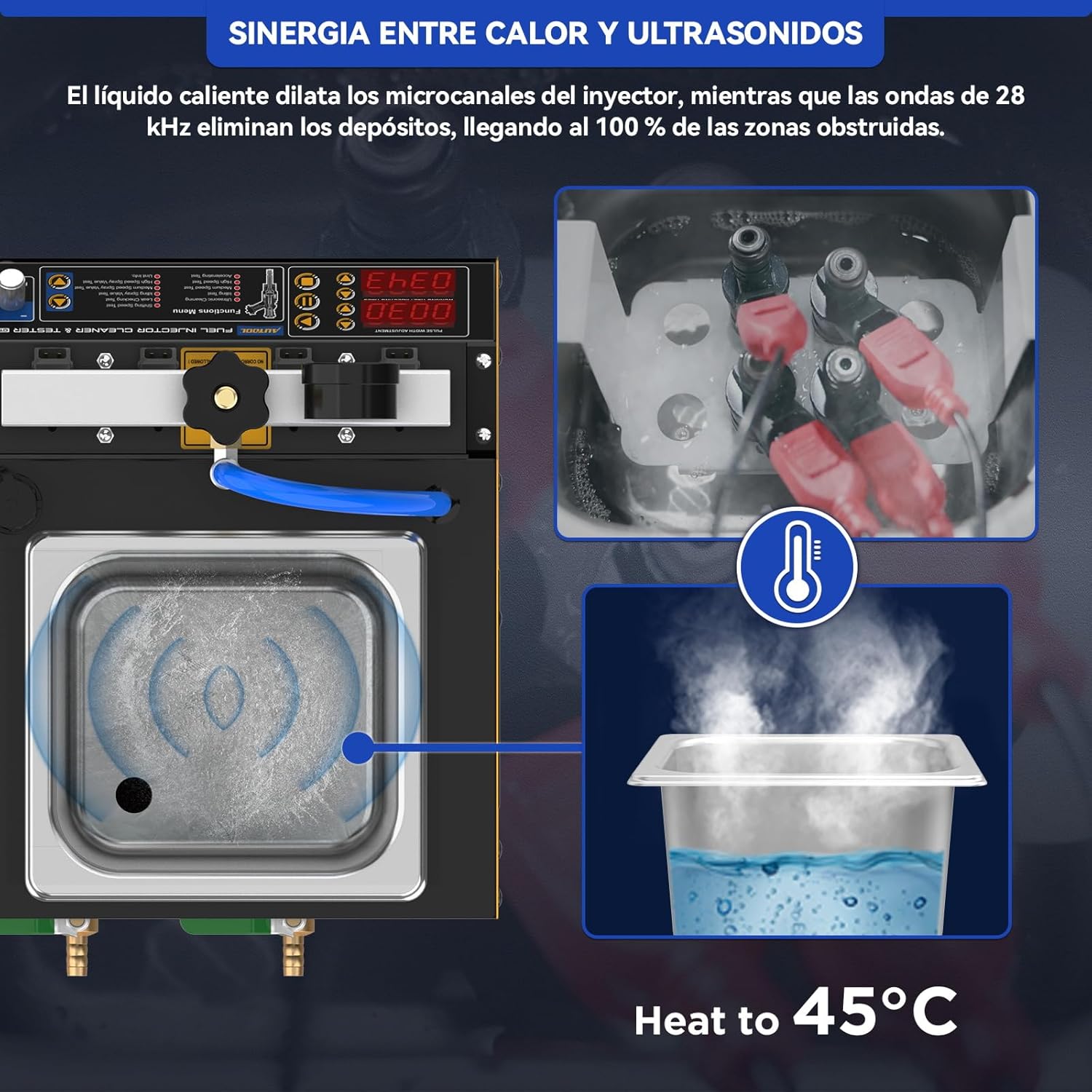
If you’ve ever watched a technician drop a set of dirty fuel injectors into a small tank of liquid and pull them out 20 minutes later looking factory-fresh, you’ve seen ultrasonic cleaning in action. The technology works by running electrical current through a transducer — a device that converts electricity into high-frequency vibration — which creates millions of microscopic bubbles in the cleaning fluid. Those bubbles collapse violently against every surface they touch (a process called cavitation), scrubbing away varnish, carbon, and fuel-deposit buildup at a microscopic level that no chemical soak or spray can match on its own. For a shop handling GDI engines — the direct-injection platforms notorious for carbon accumulation — or diesel injectors fouled by biodiesel blends, an ultrasonic rig turns a labor-intensive cleaning job into a repeatable, billable service. This guide is written for the shop owner or service manager who already understands why to buy one and needs to know which specs separate a workhorse from a disappointment.
| EDITOR'S PICK[AUTOOL Fuel Injector Cleaner an…](https://www.amazon.com/dp/B0CBLSFKST?tag=greenflower20-20) | Mid-tier[MR CARTOOL V309 GDI Fuel Inject…](https://www.amazon.com/dp/B09QKWCXT2?tag=greenflower20-20) | Budget pick[NORTHWEST ENTERPRISES Ultrasoni…](https://www.amazon.com/dp/B09KK6KR3Z?tag=greenflower20-20) | |
|---|---|---|---|
| Tank capacity | 67.63 oz | — | — |
| Cylinders | 6 | 4 | — |
| Voltage | 12V/70V/120V | 110V/220V | — |
| Display | Color | — | — |
| Cleaning functions | 3 | — | — |
| Fuel types | GDI, EFI, FSI | GDI, EFI, FSI | — |
| Price | $699.00 | $439.91 | $44.98 |
| See on Amazon → | See on Amazon → | See on Amazon → |
The Three Specs That Actually Drive Cleaning Performance
Walk into any industrial supply catalog or browse the import-heavy listings that populate online marketplaces in 2026 and you’ll find ultrasonic cleaners priced anywhere from $80 to $2,000+. The price spread is real, and it tracks to three specifications that operators in long-run shop reviews consistently cite as the difference between a machine they rely on and one that collects dust.
1. Ultrasonic Frequency (kHz)
Frequency is measured in kilohertz and describes how fast the transducer vibrates per second. Lower frequencies (28–40 kHz) generate larger, more aggressive cavitation bubbles — ideal for removing heavy carbon deposits and fuel varnish from steel and aluminum injector bodies. Higher frequencies (80–130 kHz) produce smaller, gentler bubbles suited for delicate components or precision surfaces. For fuel injector work specifically, published spec comparisons across professional-grade machines consistently land in the 28–40 kHz range as the primary cleaning band. Machines marketed at 80 kHz or above for automotive injectors are often better suited to jewelry or optical cleaning; they’re not wrong, they’re just optimized for the wrong job.
2. Ultrasonic Power (Watts) vs. Tank Volume
This is where budget machines consistently fall short. Underhood Service’s coverage of shop equipment notes that effective cavitation requires a minimum power density — roughly 10 watts per liter of tank volume — to sustain bubble formation throughout the bath. A machine rated at 120W with a 6-liter tank clears that threshold. A machine rated at 120W with a 15-liter tank does not, and operators consistently report uneven cleaning results: the injectors nearest the transducer plate come out clean while ones at the far end of the tank show residual deposit patterning. When you’re evaluating a machine, divide stated wattage by tank liters. If the ratio falls below 10:1, the manufacturer is selling tank size at the expense of cleaning performance.
3. Heating Element and Temperature Range
Ultrasonic cavitation is significantly more effective in warm fluid. Most professional automotive cleaning applications run between 50°C and 70°C (122°F–158°F). Machines without a built-in heater — or with heaters that top out at 40°C — force operators to pre-heat fluid separately, adding workflow steps and reducing temperature consistency across a batch. Engine Labs’ coverage of injector cleaning protocols specifically notes that temperature-controlled cleaning cycles improve deposit removal efficiency and allow repeatable results across different technicians. Look for a machine with a PID controller (a feedback loop that holds the bath at a set temperature) rather than a simple on/off heating switch. The PID matters less for a one-off cleaning and a lot for a shop running 8–10 injector sets per week.
Tank Size, Basket Configuration, and the Injector Workflow You’re Actually Running
The “right” tank size is a function of your workflow, not a universal answer. Here’s the honest matrix:
| Shop Type | Recommended Tank | Rationale |
|---|---|---|
| General repair, occasional injector service | 3–6 liters | Handles 4–6 port injectors per cycle; lower overhead |
| Performance/import specialist, regular GDI service | 6–10 liters | Accommodates 8-cylinder sets; fits longer GDI injectors |
| Diesel fleet service or high-volume shop | 10–20 liters | Batch processing; paired with flow-testing station |
Beyond raw volume, the basket configuration is underrated. Most entry-level machines ship with a single perforated basket that sits flat on the tank floor. For injectors, that configuration is suboptimal: injectors are long, narrow components that benefit from vertical or angled suspension so that cavitation reaches the pintle (the moving needle at the injector tip) and the filter basket at the inlet end simultaneously. Motor Age’s shop-equipment coverage highlights vertical injector holders — often sold as accessories or included with professional-grade machines — as a meaningful upgrade in cleaning consistency, particularly for multi-hole GDI injectors where deposit geometry is asymmetric.
If you’re sourcing a machine in the $300–$600 range and it doesn’t include a vertical holder, budget $30–$60 for an aftermarket injector rack. It’s not glamorous, but operators report it’s the single easiest upgrade to cleaning uniformity.
Cleaning Fluid: What Goes in the Tank Matters as Much as the Machine
An ultrasonic cleaner is a mechanical delivery system. The chemistry in the bath is doing a significant share of the actual deposit removal, and this is where a lot of first-time buyers under-invest.
The SAE technical paper on fuel injector deposit formation and removal mechanisms (SAE 2019-01-0036) describes two primary deposit types in modern injectors: waxy, higher-molecular-weight paraffin deposits that respond well to solvent-based cleaning media, and harder, polymerized carbon deposits — particularly common in GDI intake-side and injector-tip buildup — that require either higher temperature soak time or dedicated detergent-based aqueous cleaners.
For most port-injection and throttle-body injector work, a diluted automotive-grade aqueous cleaner (purpose-formulated for ultrasonic use, typically available from BG Products, Wynn’s professional line, or generic ultrasonic cleaner concentrate) handles the job at 50–60°C with a 20–30 minute cycle. For GDI injectors with hard carbon at the tip — the failure mode that Popular Mechanics’ explainer on GDI engine maintenance identifies as the primary driver of misfire and lean-condition codes on high-mileage turbocharged platforms — some operators pre-soak injectors in a PEA-concentrated (polyetheramine) fuel additive solution before the ultrasonic cycle, then run the ultrasonic bath as a rinse and final clean. The combination addresses both deposit types in sequence without exceeding the injector’s thermal limits.
What to avoid: Do not use straight isopropyl alcohol or acetone in a standard ultrasonic tank unless the machine is explicitly rated for flammable solvents and equipped with an explosion-proof transducer enclosure. The flash-point risk is real and documented. Most shop-grade machines in the $300–$1,500 range are not solvent-rated.
By the Numbers: Quick Spec Sanity-Check
Before signing any purchase order, run every candidate machine through this four-line filter:
Frequency: 28–40 kHz for automotive injectors? ✓
Power density: Watts ÷ tank liters ≥ 10? ✓
Temperature control: PID-regulated heater to 70°C? ✓
Basket/holder: Vertical injector rack included or available? ✓
A machine that passes all four is worth evaluating on price and warranty. A machine that fails two or more is a coin flip at best — and shop owners in aggregated reviews consistently describe the low-spec machines as “fine for small parts” but frustrating for injector-specific work where repeatability drives customer confidence.
Flow Testing: The Spec That Separates a Cleaning Service from a Diagnostic Service
This section is worth its own article, but any serious injector service operation eventually confronts it: ultrasonic cleaning removes deposits, but it doesn’t tell you whether a cleaned injector is flowing to spec. A GDI injector cleaned to visual perfection can still have a worn pintle seat that causes a 15–20% lean deviation on that cylinder — and if you return that injector to service without flow-testing it, you own the comeback.
Engine Labs’ injector service protocol coverage draws a clear line between shops that offer “cleaning” (ultrasonic bath + visual inspection) and shops that offer “cleaning and flow testing” (ultrasonic bath + electronic pulse-testing on a purpose-built flow bench). The second service commands $30–$80 more per set in most markets, and it’s defensible — you’re handing the customer a spec sheet, not just clean hardware.
Dedicated injector flow-test benches run $800–$2,000 in 2026 pricing from suppliers like Injector RX and Automotive Test Solutions. If your shop is doing injector service on late-model GDI platforms where injectors routinely cost $80–$200 each, adding flow-test capability to your service turns a cost-of-goods conversation into a diagnostic value conversation. That’s a different margin structure entirely.
The Decision Rule
If you’re the shop owner with a machine decision pending, here’s the honest if/then framework:
If your shop sees 2–4 injector cleaning jobs per month and most of them are port-injection or older throttle-body work, then a 3–6 liter, 40 kHz machine in the $300–$500 range with an external vertical holder covers the job and returns ROI within 6–8 cleanings.
If your shop regularly services GDI turbocharged platforms — BMWs, Audis, VW TSI engines, Ford EcoBoosts, or any modern 4-cylinder running direct injection — then you need a 6–10 liter machine with PID temperature control and you should budget for a flow-test station alongside it. Underhood Service’s GDI service coverage is consistent on this point: the carbon deposit profile on these engines makes injector service a higher-margin, higher-liability job simultaneously. The machine investment ($700–$1,200) is recovered in 15–20 jobs; the liability protection from flow-testing is harder to quantify but real.
If you’re running a diesel fleet account or processing 10+ injector sets per week, then the 10–20 liter commercial-grade machines with industrial heaters and stainless basket systems are the appropriate tier, and the buying question shifts from specs to vendor support — parts availability, transducer warranty, and whether the manufacturer provides application-specific cleaning protocols for common diesel injector families (Bosch CRDI, Delphi, Denso).
The machine you buy is infrastructure. Buy it to the workflow you’re running 18 months from now, not the workflow you have today — and buy it to the specs above, not to the marketing copy on the front of the box.