May 31, 2026 • Dale Merrick • 11 min reading time • Prices verified June 5, 2026
Throttle Body, Intake Valve, and Combustion Chamber Cleaners: Matching the Right Spray to the Right Problem
If you’ve ever stood in an auto parts aisle staring at three different spray cans — one labeled “throttle body cleaner,” one labeled “intake cleaner,” and one labeled “combustion chamber treatment” — and wondered whether they’re basically the same thing, you’re not alone. They’re not the same thing. Each one is formulated to attack a specific type of deposit at a specific location in the path air and fuel travel before combustion happens. The throttle body is the valve that controls airflow into the engine; the intake valves are the gates that let that air-fuel mixture into each cylinder; the combustion chamber is where ignition actually occurs. Gunk builds up differently in each zone, and the chemistry needed to dissolve it differs accordingly. This guide sorts out which product solves which problem, shows you the math on when aerosol treatment is enough versus when you need a more serious intervention, and gives you a clear decision framework before you spend a dollar.
Why Location Changes Everything: Three Zones, Three Deposit Chemistries
The confusion in the aerosol cleaner category starts with a fundamental truth that manufacturer marketing routinely obscures: deposit chemistry changes depending on where in the engine you are.
In the throttle body, you’re dealing primarily with oil vapor and crankcase blow-by residue (oil mist that recirculates through the PCV system) baked onto the throttle plate and bore walls at relatively low temperatures. These deposits are oily, sticky, and carbon-tinged — but they respond well to aggressive solvent chemistry because the throttle body is accessible and can be sprayed directly with the engine off or at idle.
Move deeper into the intake tract — past the throttle body, through the intake manifold, and onto the backs of the intake valves — and the deposit character changes. SAE Technical Paper 2019-01-0035 on port fuel and direct injection carbon formation documents this clearly: on GDI (gasoline direct injection) engines, fuel is sprayed directly into the cylinder rather than upstream of the intake valve, which means the intake valve backside never gets bathed in detergent-laden fuel. The result is baked-on polymerized carbon deposits — think enamel, not oil film — that accumulate over 30,000 to 80,000 miles and eventually restrict airflow into the cylinder. This is the deposit chemistry that has made walnut blasting (physically blasting crushed walnut shells into the intake ports) a standard service item for high-mileage GDI engines, as documented in Underhood Service’s 2023 overview of GDI carbon buildup service solutions.
In the combustion chamber itself, you’re dealing with combustion byproducts — partially burned fuel, oil ash, and carbon — that can create hot spots, raise the effective compression ratio, and contribute to pre-ignition (knock). These deposits respond to chemistry that can survive combustion temperatures and still exert a cleaning or softening action — a different ask than simple solvent action at the throttle body.
Here’s the practical split:
| Zone | Deposit Type | Cleaning Approach |
|---|---|---|
| Throttle body | Oily PCV residue, soft carbon | Direct solvent spray (engine off or at idle) |
| Intake valve backs (GDI) | Polymerized hard carbon | Aerosol upstream spray, walnut blast for heavy buildup |
| Combustion chamber | Combustion byproduct carbon | Fuel-borne chemistry or top-engine aerosol treatment |
Throttle Body Cleaners: What They Do, What They Don’t
Throttle body cleaners are the most straightforward product in this category. They’re fast-evaporating solvent formulas — typically acetone-forward or ketone blends with some lubricant added to condition the throttle plate shaft seals. You spray them directly onto the throttle plate with the engine off, wipe, and done. Products like CRC Throttle Body and Air Intake Cleaner and Berryman B-12 Chemtool are purpose-built for this job.
What reviewers across aggregated purchase data consistently note about Berryman products specifically: the level of diagnostic specificity is unusual for an aerosol treatment. One documented owner account describes a P0303 misfire on a Mini Cooper S — a platform with known intake carbon buildup tendencies — that persisted after plug and coil replacements and resolved following aerosol treatment directed into the intake path. That’s a useful data point, though the mechanism is ambiguous: whether the Berryman chemistry addressed a throttle body restriction, light intake deposit, or combustion chamber deposit is hard to isolate from a single owner report. The honest framing is that this product category can occasionally punch above its weight on mild-to-moderate buildup when applied correctly — and rarely causes harm when it doesn’t fully solve the problem.
Where throttle body cleaner cannot help: once you’re past the throttle plate and onto the valve backs of a GDI engine with significant mileage, you need a different tool.
GDI Intake Valve Aerosols: The Maintenance vs. Remediation Distinction
This is where the category gets genuinely confusing — and where most buyer disappointment originates.
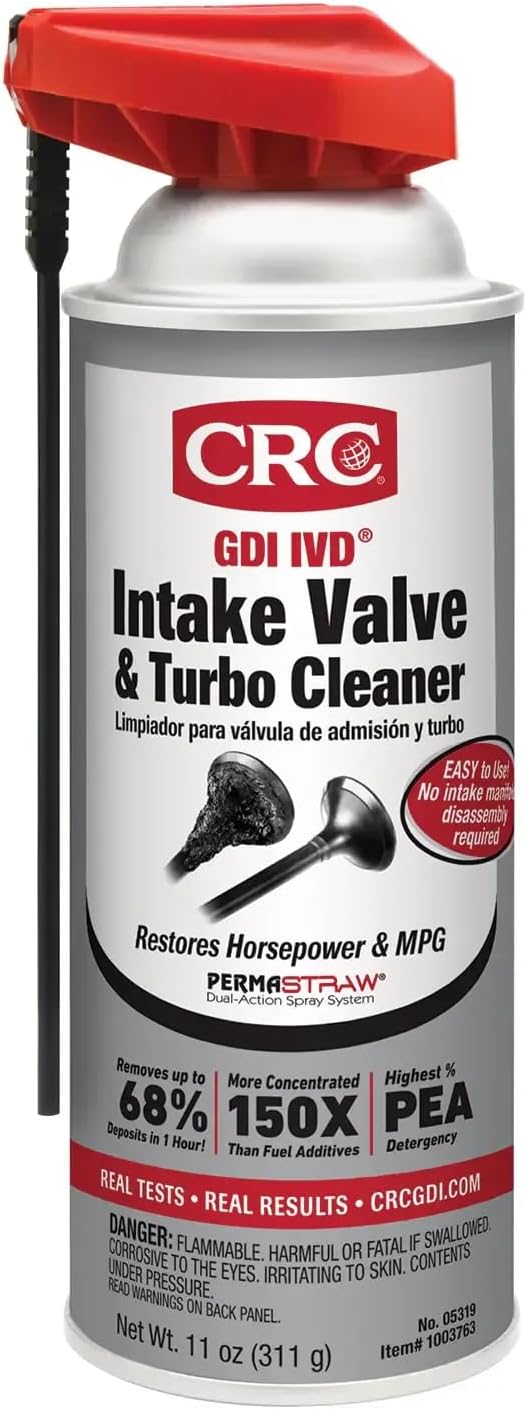
CRC GDI IVD Intake Valve & Turbo Cleaner is the most reviewed product in this subcategory, and the pattern in aggregated buyer feedback is remarkably consistent, as the Liqui-Moly Di-Jectron reviews echo from a different brand angle: buyers who frame it as maintenance report satisfaction; buyers who frame it as remediation report disappointment. One reviewer explicitly called CRC GDI IVD a “band-aid” and still gave it five stars — because they understood its role. That’s the distinction you need to internalize before you recommend or buy anything in this category.
CRC GDI IVD’s technical data sheet positions it as an intake-path treatment applied upstream of a running engine — you remove the air intake hose upstream of the throttle body and spray into the airstream in short bursts while the engine idles. The aerosol carries solvent into the intake manifold, across the intake valve backs, and into the combustion chamber. The chemistry CRC uses is engineered to soften and mobilize polymerized carbon deposits. The limitation — stated honestly in CRC’s own product literature and confirmed by the reviewer pattern — is that this works well on early-stage or maintenance-interval carbon accumulation. By the time a GDI engine at 80,000+ miles has significant valve deposit restriction, no aerosol treatment is going to dissolve what walnut blasting removes mechanically.
The Liqui-Moly Di-Jectron angle: The Di-Jectron line from Liqui-Moly generates a distinct buyer population — European car owners and enthusiasts familiar with Liqui-Moly’s OEM-adjacent approval credentials. One aggregated owner report on a twin-turbocharged 3.3-liter application noted fuel economy improvement from approximately 15 to nearly 20 MPG following Di-Jectron treatment alongside other supporting maintenance items (fresh plugs, air filter, oil service). That’s a real owner’s reported experience, and it’s worth noting — but the supporting maintenance confounds attribution significantly. A 33% fuel economy improvement from an aerosol cleaner alone would be extraordinary; as part of a multi-item service, it’s plausible that the combined effect is real. Liqui-Moly’s application guide for the Di-Jectron series specifies it as a fuel-tank additive in standard configuration, not a direct intake spray — an important distinction addressed in the FAQ below.
By the numbers — aerosol treatment vs. walnut blasting:
- Aerosol GDI intake cleaner (e.g., CRC GDI IVD): ~$12–$18 per can, 1–2 cans per treatment
- Professional walnut blast service (independent shop): $300–$600 labor typical, 2026 market rates
- Recommended aerosol maintenance interval: every 10,000–15,000 miles on GDI engines per manufacturer guidance
- Walnut blast threshold: typically triggered by carbon-related codes, measurable power loss, or physical inspection at 60,000–80,000 miles
The math strongly favors running aerosol maintenance on schedule — not to replace walnut blasting when it’s needed, but to extend the interval before it is.
Combustion Chamber Treatments: The Upper-Cylinder Chemistry Tier
Products like BG 44K and Liqui-Moly Pro-Line Motorspülung operate partly as combustion chamber treatments — their PEA (polyether amine) chemistry survives the fuel delivery pathway and reaches the combustion chamber through normal injection. Aerosol combustion chamber treatment is a different delivery method: the product goes in upstream and reaches the chamber through the intake path rather than through the fuel.
The key specification difference from throttle body and intake aerosols: combustion chamber-rated aerosols need to be formulated to not harm O2 sensors or catalytic converters. This is a real concern and addressed directly in the FAQ below — but the short version is that correctly formulated products from reputable manufacturers are catalyst-safe when used as directed. Car and Driver’s 2023 overview of GDI engine maintenance notes that catalyst compatibility is a standard certification requirement for any upper-engine aerosol reaching the EPA Tier 3 market.
Popular Mechanics’ 2022 feature on GDI engine carbon buildup makes the point that combustion chamber cleaning via aerosol is most useful at moderate mileage — it softens deposits enough that they can burn off over subsequent heat cycles, rather than causing pre-ignition events from hard, high-spot deposits. At severe buildup levels, the same mechanical-vs.-chemical argument applies.
Frequently Asked Questions
Can you use a GDI-specific aerosol intake cleaner in a port-injected engine without damage?
Yes, without meaningful risk. Port-injected engines don’t develop the same severe intake valve carbon buildup as GDI engines (because fuel washes the valve backs on every cycle), but GDI-rated aerosols like CRC GDI IVD are chemically compatible with port-injected intake systems. You won’t cause harm; you also won’t see dramatic results because the carbon problem being targeted doesn’t exist at the same severity.
How often should you run an aerosol intake cleaner versus a tank-based cleaner?
These solve different problems on different schedules. A tank-based cleaner (BG 44K, Techron Concentrate Plus, Liqui-Moly Di-Jectron) addresses fuel system and combustion chamber deposits through the fuel path and is typically run every 5,000–15,000 miles or at oil-change intervals. An aerosol intake treatment (CRC GDI IVD, Berryman) directly targets intake valve deposits and is most useful every 10,000–15,000 miles on GDI-equipped vehicles as a maintenance measure. They’re complementary, not redundant.
Does the Liqui-Moly Di-Jectron work through the fuel tank, or does it have to be sprayed directly into the intake?
Per Liqui-Moly’s own product application guide, the standard Di-Jectron (the liquid additive, not the Pro-Line aerosol) is a fuel-tank addition — it travels through the fuel system and reaches injectors and combustion chambers through normal operation. It does not function as a direct intake spray. If you want direct intake valve contact, Liqui-Moly’s Pro-Line intake system cleaner aerosol is the correct product. Confusing these two delivery mechanisms is a common source of misapplication in review threads.
What is the correct throttle body reset procedure after using a throttle body cleaner spray?
After cleaning the throttle body, many modern vehicles — particularly those with drive-by-wire (electronic) throttle systems — require a throttle position reset so the ECU relearns the idle position of the cleaned plate. The exact procedure varies by make and model, but the general sequence involves disconnecting the battery for 15–30 minutes (or using a scan tool to clear the adaptive throttle values), then performing a key-on/engine-off cycle followed by an extended idle to allow the ECU to relearn. Consult the factory service manual for your specific platform — this step is frequently skipped and causes idle hunting complaints that get blamed on the cleaner product.
Will an intake valve aerosol cleaner damage O2 sensors or the catalytic converter?
Reputable formulations from established manufacturers (CRC, Berryman, Liqui-Moly) are engineered and marketed as catalyst-safe when used according to directions. The risk scenario is overuse — saturating the intake rather than applying in measured bursts — which can temporarily foul O2 sensor readings or cause a rich-combustion event that overwhelms a borderline catalytic converter. Follow the directed application quantity precisely. If you’re working on a vehicle with a known failing cat or a compromised O2 sensor, defer aerosol treatment until those components are addressed.
The Decision Framework
If you’re at the point-of-purchase or recommendation decision right now, here’s the clean if/then map:
-
If the issue is idle surge, rough throttle response, or a visible oily ring on the throttle plate → throttle body spray, direct application, engine off. This is the simplest, fastest intervention.
-
If you’re maintaining a GDI engine under 60,000 miles and want to push the walnut blast interval → aerosol GDI intake cleaner on schedule. CRC GDI IVD is the most documented product in this application; Di-Jectron fuel additive as a complementary combustion chamber treatment.
-
If you have a GDI engine over 60,000–80,000 miles with diagnosed carbon-related codes, measured power loss, or a shop inspection showing heavy valve deposits → walnut blasting is the correct primary service. Aerosol treatment as a post-blast maintenance protocol is reasonable; aerosol as a substitute for the mechanical service is not.
-
If the goal is combustion chamber deposit control on any platform → tank-additive PEA chemistry (BG 44K, Techron Concentrate Plus, Liqui-Moly Pro-Line Motorspülung) run on interval is the highest-leverage tool; aerosol combustion treatment is a useful supplement at moderate mileage.
The recurring complaint in buyer reviews across this entire category — that people don’t know which product goes where — is a marketing failure, not a chemistry failure. The products largely do what they claim. The job is matching the right chemistry to the right location, which is exactly what this guide is for.