September 18, 2026 • Dale Merrick • 11 min reading time • Prices verified June 5, 2026
Small Engine Fuel Additives: What Actually Restarts a Stubborn Lawn Mower
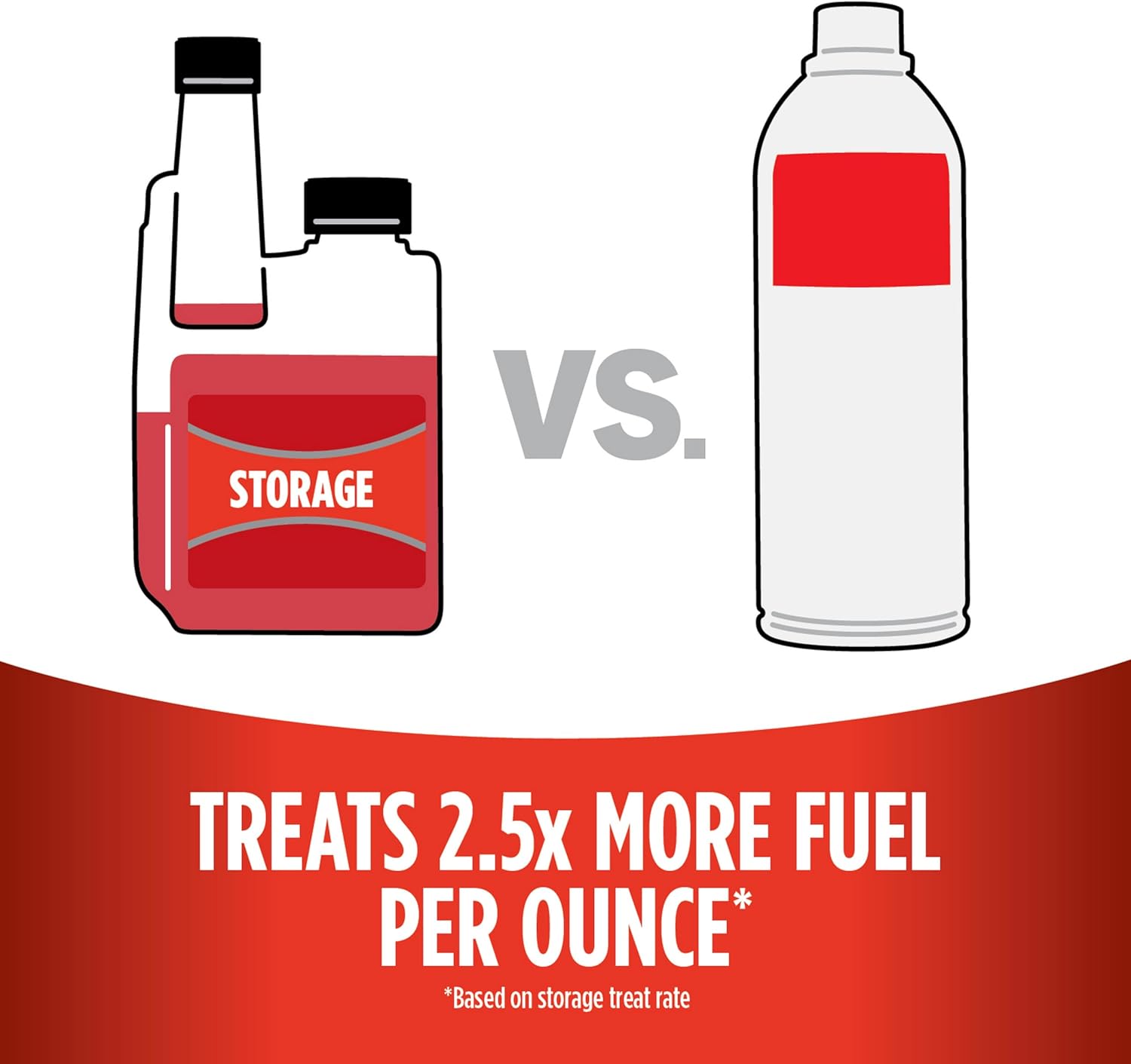
If your mower turned over fine in October and now it coughs, bogs, or dies at idle the moment spring arrives, you’re dealing with one of the most common small-engine problems on the planet: fuel degradation. Modern pump gasoline — especially the E10 blend sold at most U.S. stations — starts breaking down chemically in as little as 30 days. That degradation leaves behind a sticky, lacquer-like residue called varnish inside the carburetor, the small device that mixes fuel and air before combustion. The result is a mower that starts on the first pull but stumbles and dies, or won’t idle cleanly at all. Fuel additives are chemicals you pour into the gas tank to either prevent that varnish from forming in the first place, or to dissolve it after the fact. This article explains which type you actually need — and why getting that distinction wrong is the single most common reason people walk away frustrated.
The short version: prevention additives and recovery additives are not interchangeable. The product lineup from a single brand can include both, and they look nearly identical on a shelf. Reading the wrong label has caused thousands of unnecessary carb cleanings. Let’s fix that.
| EDITOR'S PICKRoyal Purple Max-Clean Fuel Sys… | Mid-tierSTA-BIL Storage Fuel Stabilizer | Budget pickSTA-BIL 360 Protection Ethanol… | |
|---|---|---|---|
| Volume | 20 oz | 32 oz | 4 oz |
| Treats | — | 80 gal | 5 gal |
| Freshness | — | 24 months | — |
| Cleans | ✓ | — | ✓ |
| Ethanol Treat | — | — | ✓ |
| Price | $11.64 | $10.61 | $6.99 |
| See on Amazon → | See on Amazon → | See on Amazon → |
The Pre-Storage vs. Post-Storage Distinction: Why It Changes Everything
This is the structural fact every small-engine owner needs to internalize before opening a bottle.
Pre-storage additives — also called fuel stabilizers — are designed to be added to fresh fuel before the engine sits. They work by slowing the oxidation process, essentially putting the chemical clock on pause so that varnish and gum deposits don’t form during months of inactivity. STA-BIL Storage formula is the canonical example. According to Gold Eagle Co.’s published product technical sheets, STA-BIL Storage is formulated for fuel that will sit up to 12 months, and it explicitly requires running the engine for several minutes after adding the product so the treated fuel circulates through the entire carburetor circuit.
The critical detail: STA-BIL Storage does not dissolve varnish that has already formed. It is a preventive, not a cure. If you pour it into a mower that’s already idling rough or refusing to start cleanly, you are not giving it the tool it needs. Reviewers who report disappointment with STA-BIL Storage in recovery scenarios are almost universally making this category error — they bought a prevention product and expected recovery behavior.
Post-failure or recovery additives work differently. STA-BIL Fast Fix is Gold Eagle Co.’s answer to the engine that already has a problem. Per Gold Eagle’s product documentation, Fast Fix is a concentrated carburetor cleaner in liquid form, dosed directly into the tank, that circulates through the fuel system to dissolve the light varnish and gum buildup responsible for rough idle and stalling. Across aggregated owner accounts, the pattern is consistent: an engine that starts but dies at idle, treated with less than an ounce of Fast Fix in fresh fuel, running cleanly within minutes of operation.
The sequencing matters enormously: siphon old fuel first, add fresh fuel, then add Fast Fix. Adding Fast Fix on top of old degraded fuel undermines the chemistry before it starts.
How to Choose: Three Scenarios, Three Products
Understanding which additive fits your situation is easier when you map products to concrete failure modes. The three H3 sections below walk through the most common small-engine scenarios and assign each one a tier based on the level of intervention required.
H3: The Seasonal Storage Scenario — Prevention Before Problems Start
You ran the mower through the season, it performed fine, and now it’s October. The goal is to make sure it pulls cleanly next May without a carburetor cleaning in between. This is the lowest-stakes scenario, and it calls for the most basic intervention.
STA-BIL Storage or STA-BIL 360 Protection are both appropriate here, with one meaningful distinction. STA-BIL Storage addresses oxidation — the primary decomposition mechanism for fuel sitting in a sealed tank. STA-BIL 360 adds ethanol protection chemistry engineered for E10 and E15 fuels, addressing the hygroscopic (water-attracting) behavior of ethanol blends in addition to oxidation. Per Popular Mechanics’ lawn mower winterization coverage (popularmechanics.com, 2024), ethanol-blended fuels are the primary culprit in modern small-engine carburetor failures, making ethanol-specific treatment a meaningful upgrade in markets where E10 is standard — which the U.S. Environmental Protection Agency’s consumer advisory on ethanol and small engines notes is the case across most of the continental United States.
Gold Eagle Co. technical sheets specify: for STA-BIL Storage, dose at 1 oz per 2.5 gallons of fuel and run the engine five minutes. For STA-BIL 360 Protection, dose at 1 oz per 5 gallons year-round.
The correct move: Fill the tank, dose with STA-BIL Storage or STA-BIL 360, run the engine five to ten minutes to circulate treated fuel through the carb, then store. Do not run the tank dry — the treated fuel left in the system protects rubber seals and metal components from drying out over winter. Running dry was sound advice in an era before stabilizers; with treated fuel, it’s counterproductive.

STA-BIL 22295
$6.99
In stock on Amazon
Check price on AmazonH3: The Spring Recovery Scenario — Engine Already Running Rough
You didn’t treat the fuel last fall. The mower starts but won’t hold an idle, bogs at full throttle, or surges unevenly. The carburetor has varnish deposits on the jets. This calls for a recovery tool, not a storage stabilizer — a distinction that Consumer Reports’ lawn mower maintenance guidance (consumerreports.org, 2025) underscores by recommending owners address the specific failure mode rather than defaulting to whichever fuel additive is nearest on the shelf.
STA-BIL Fast Fix is the direct-action answer here. Per Gold Eagle Co.’s product documentation, Fast Fix is designed specifically for engines already showing symptoms: rough idle, stalling, hesitation after restart. The correct procedure is to siphon the degraded fuel from the tank, refill with fresh gasoline, and add Fast Fix at approximately 0.5 oz per gallon. Run the engine through the tank. In the majority of light-to-moderate varnish cases — engines that sat one to two seasons without treatment — this is sufficient to restore normal idle behavior.
If the engine still won’t idle normally after one treated tank, the carburetor likely requires physical cleaning or rebuild. At that point, no in-tank additive will substitute for pulling the carb and soaking the jets in aerosol carb cleaner or a dedicated soak solution. Fast Fix addresses dissolved or semi-hardened varnish; it cannot dislodge deposits that have fully polymerized on jet surfaces.
The correct move: Siphon old fuel. Fresh fuel plus Fast Fix. Run one full tank before deciding the carb needs a bench cleaning.
STA-BIL
$10.61
In stock on Amazon
Check price on AmazonH3: The Fleet Maintenance Scenario — Ongoing Treatment Across Multiple Machines
You manage several small engines — a walk-behind mower, a riding mower, a string trimmer, possibly a snowblower — all running E10 fuel, all needing consistent protection without seasonal scrambling. The goal is a single maintenance product that handles ongoing fuel conditioning across the fleet with minimal per-tank cost and maximum flexibility.
Star Tron Enzyme Fuel Treatment fits this use case well. Where stabilizers slow oxidation through chemistry, Star Tron’s formulation — per Star brite Inc.’s published product FAQ and dosing guide — uses enzymes to break down fuel degradation byproducts and modify the way ethanol behaves in the tank. The mechanism reduces fuel surface tension and breaks degradation compounds into particles small enough to burn off during normal combustion rather than depositing as varnish. It also partially addresses mild phase separation, the process by which ethanol pulls atmospheric moisture and separates from gasoline in a sitting tank.
Dosing reality check: Star brite’s published dosing guide specifies 1 oz per 6 gallons for standard maintenance treatment, or 1 oz per 3 gallons for a conditioning treatment on fuel of uncertain age. A standard walk-behind mower tank holds between 0.5 and 1.5 gallons. That means a maintenance dose for one mower fill is roughly one-third of an ounce — about two teaspoons. The bottles are sized for marine applications and large equipment. The per-tank cost is extremely low, and a single bottle treats a season’s worth of small-engine fills for most homeowners.
What Star Tron cannot do: dissolve heavy varnish deposits that have already cured on carburetor jets. The U.S. Environmental Protection Agency’s consumer advisory on ethanol and small engines notes that once varnish has fully polymerized on metal jet surfaces, solvent-based cleaners or physical cleaning are required. Star Tron is a maintenance and mild-recovery tool, not a heavy-duty carb cleaner. If an engine is already symptomatic, reach for Fast Fix first; once it’s running cleanly, Star Tron is an appropriate ongoing treatment to keep it that way.
The correct move: Add Star Tron at maintenance dose to every tank fill across the fleet. Use the 1 oz per 3 gallon rate for any engine returning from a period of uncertain storage.
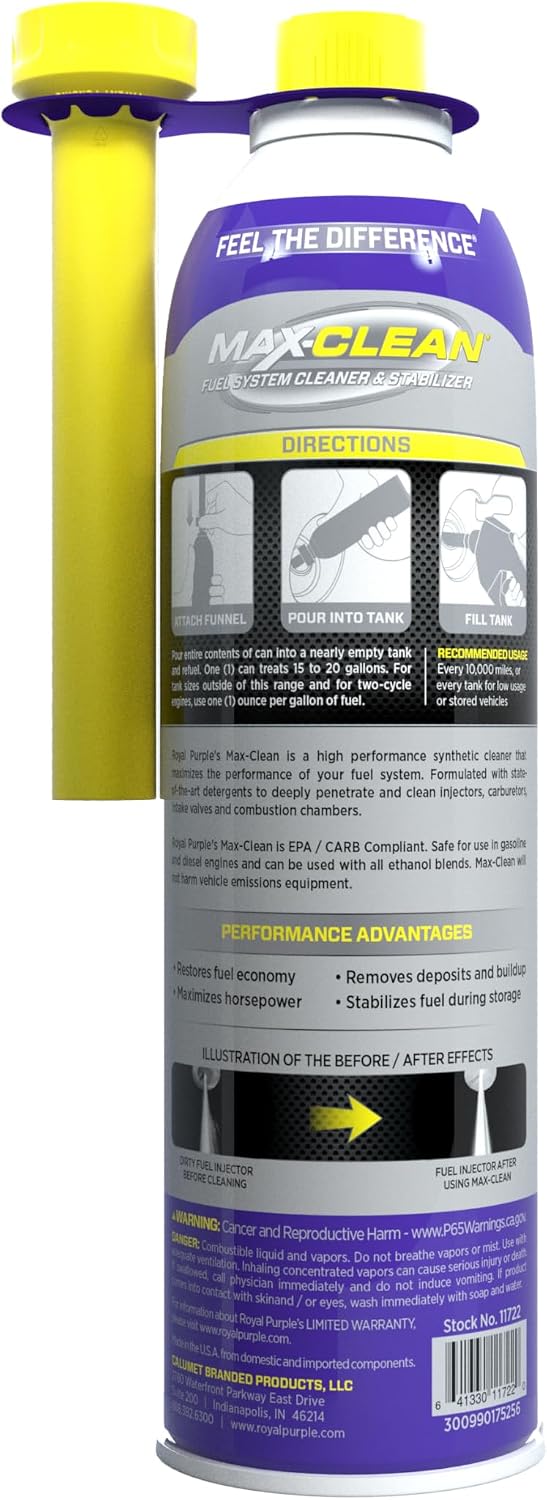
Royal
$11.64
In stock on Amazon
Check price on AmazonComparison at a Glance
| Product | Primary Function | Correct Scenario | Dose (1-gal tank) | Treated Fuel Life |
|---|---|---|---|---|
| STA-BIL Storage | Oxidation inhibition | Fresh fuel, pre-storage | ~0.4 oz | Up to 12 months |
| STA-BIL 360 Protection | Oxidation + ethanol protection | Year-round E10 treatment | ~0.2 oz | Up to 12 months |
| STA-BIL Fast Fix | Solvent carb cleaner | Engine already running rough | ~0.5 oz | N/A (recovery use) |
| Star Tron Enzyme | Enzyme fuel conditioning | Ongoing fleet maintenance | ~0.17 oz (maint.) | Up to 2 years |
Dosing figures drawn from Gold Eagle Co. and Star brite Inc. published product specifications and label directions.
Frequently Asked Questions
Can I add STA-BIL Storage after my mower already won’t idle smoothly?
No — and this is the most common and expensive mistake in the small-engine additive category. STA-BIL Storage is formulated to prevent varnish formation in fresh fuel, not to dissolve deposits that have already formed. If your engine is already stumbling or stalling, you need STA-BIL Fast Fix or a physical carburetor cleaning. Gold Eagle Co.’s product technical sheets describe the two products separately, with distinct formulations and explicitly different use-case language.
Is Star Tron safe to use every tank, or only for storage?
Star Tron is designed for continuous use. Star brite Inc.’s product FAQ describes ongoing maintenance dosing as the primary use case — adding it to every fill-up rather than only at seasonal transitions. This continuous approach prevents the gradual degradation that causes varnish buildup in the first place, which is why fleet users with consistent treatment histories tend to report far fewer carb problems than users who treat only at storage time.
Should I run my mower tank dry before storage?
Only if you are not using a fuel stabilizer. The “run it dry” advice predates the widespread availability of fuel stabilizers and is now generally outdated for treated storage. Gold Eagle Co.’s technical documentation for both STA-BIL Storage and STA-BIL 360 explicitly recommends leaving treated fuel in the system over winter — it protects rubber seals and metal carburetor components from drying out and cracking. If you are not treating the fuel, running dry is better than leaving untreated gasoline to varnish in place. If you are treating it, leave the treated fuel in.
Can enzyme treatments fix a carb that’s already gummed solid?
No. Enzyme treatments modify fuel chemistry and can slow or partially reverse early-stage degradation before deposits harden. Once varnish has fully polymerized on jet surfaces — which the U.S. Environmental Protection Agency’s small engine ethanol advisory identifies as a function of how long degraded fuel has been sitting — enzymatic treatment cannot dissolve it. At that stage, a solvent-based cleaner like STA-BIL Fast Fix, a carburetor soak, or physical jet cleaning is required. Star Tron is most accurately described as a maintenance and mild-recovery tool.
The Decision Rule
If your mower sat untreated and won’t idle cleanly: siphon the old fuel, add fresh fuel, add STA-BIL Fast Fix. Give it one tank to recover before considering a carburetor bench cleaning.
If your mower ran fine last season and you want it to run fine next spring: treat with STA-BIL Storage or STA-BIL 360 before putting it away, run the engine five minutes to circulate treated fuel, and leave it alone until spring.
If you’re managing multiple small engines on E10 fuel and want a single low-cost maintenance product: Star Tron at maintenance dose handles ongoing fuel conditioning across the fleet, with per-tank costs low enough to make every-fill treatment practical.
Prevention and recovery are different jobs. The chemistry is not complicated once you stop treating every bottle of fuel additive as equivalent. Match the product to the job, and the mower pulls clean on the first cord — every spring.