June 7, 2026 • Dale Merrick • 9 min reading time • Prices verified June 5, 2026
P0420 Without the $2,000 Repair Bill: What Cat Cleaners Can and Cannot Do
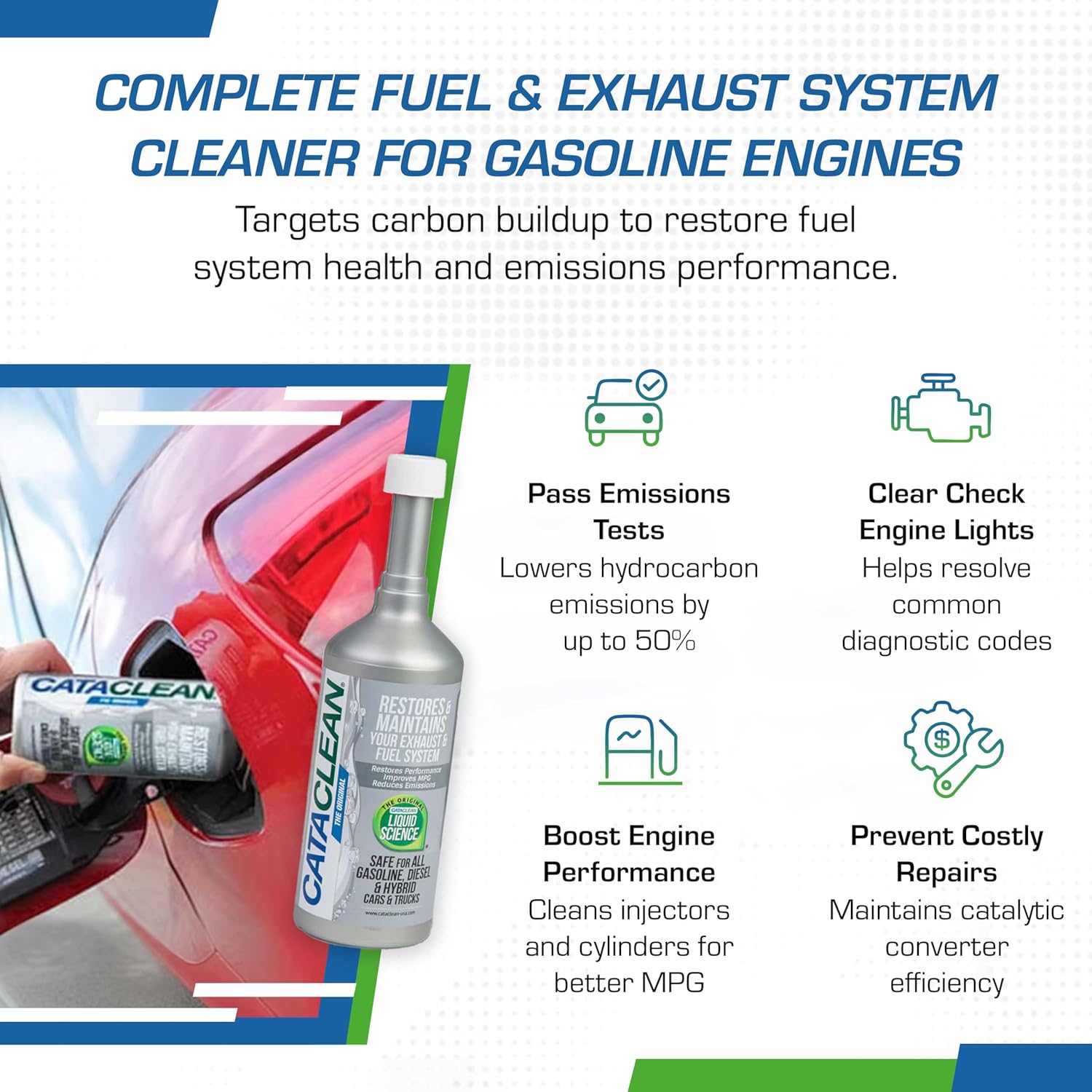
You’re driving to work when the check-engine light comes on. You pull the code at an auto parts store and get P0420 — “Catalyst System Efficiency Below Threshold, Bank 1.” A quick internet search tells you that means your catalytic converter (the exhaust component that chemically converts harmful combustion byproducts into less harmful gases before they exit the tailpipe) may be failing, and that replacement can run $800 to $2,000 or more at a shop. Before you reach for your wallet, though, you’ll notice a shelf full of products promising to clean your cat and clear that code for under $30. This guide is for the reader who wants a straight answer: do those products work, when do they work, and what does the process actually look like when it’s done correctly? We’ll name the tradeoffs, show the math, and give you clear decision rules.
What P0420 Is Actually Measuring — and Why That Matters for Chemistry
P0420 doesn’t mean your converter is physically destroyed. It means your vehicle’s ECU (engine control unit — the onboard computer) has observed that the downstream oxygen sensor (the one after the converter) is reading exhaust composition too similar to the upstream sensor (before the converter). A healthy converter should be scrubbing out enough hydrocarbons and carbon monoxide that the downstream sensor sees relatively flat, low-activity signal compared to the upstream sensor’s busy oscillation. When both sensors look roughly the same, the ECU concludes the converter isn’t doing its job.
Here’s the nuance that determines whether a cleaner can help you: that efficiency drop has multiple possible causes.
| Root Cause | Cat Cleaner Can Help? | Notes |
|---|---|---|
| Carbon/hydrocarbon deposits on catalyst substrate | Yes — this is the target | Most common in short-trip, city-cycle driving |
| Phosphorus or oil-ash poisoning of catalyst | Partially / temporarily | Engine oil consumption is the culprit; code will return |
| Physical cracking, melting, or substrate collapse | No | No chemistry reverses structural damage |
| Failing oxygen sensor (false positive) | No | Wrong diagnosis entirely — check sensor first |
| Engine misfire or rich-running condition upstream | No | Upstream damage overwhelms any additive benefit |
Per the EPA’s overview of vehicle emissions control systems, catalytic converters rely on a platinum-group metal (PGM) substrate — a ceramic honeycomb coated with platinum, palladium, and rhodium — to catalyze the conversion reactions. Carbon soot and unburned hydrocarbons can partially coat that substrate, reducing its active surface area and triggering P0420 even when the physical structure is intact. That’s the scenario where a fuel-system cleaner has a legitimate shot.
The Honest Success/Failure Split in the Review Record
Across aggregated owner reviews of the major cat cleaner products, the pattern is striking and consistent: buyers who follow a complete drive cycle protocol report disproportionately high success rates. Buyers who pour and immediately retest overwhelmingly report failure.
This isn’t a product-quality gap — it’s a chemistry-and-monitoring gap. Catalytic system cleaners work by introducing detergent chemistry (and in some formulations, oxygenate-based combustion improvers) into the fuel stream. That chemistry has to burn through the system at operating temperature, under load, long enough to volatilize and dislodge deposits from the PGM substrate surface. An ECU also won’t log a monitor as “ready” until the vehicle has completed a specific sequence of cold start, warm-up, steady-speed cruising, and deceleration — what technicians call a drive cycle. Smog tests in most states require that monitor to show “ready” before the test counts.
Cataclean generates some of the most polarized reviews in this space. Owners who pass smog after using it sometimes still describe the process as uncertain and messy — one reviewer explicitly noted they’d “try lots of other things before using Cataclean again” despite ultimately passing. That ambivalence is worth sitting with: a product can work and still be frustrating if the protocol isn’t intuitive and the outcome feels like luck.
Liqui-Moly Catalytic System Cleaner consistently draws some of the most methodical owner accounts. One Nissan Altima owner’s review stands out as a model: they ran the product on a low-fuel tank, drove a combined city-plus-freeway cycle before retesting, and described the code clearing in a way that maps precisely to what the chemistry needs — time at temperature, varied load conditions, and patience before the ECU’s readiness monitor resets. That’s not a coincidence.
Dura Lube Severe Catalytic and Exhaust Treatment shows a specific pattern worth naming: partial or temporary resolution on high-mileage Honda platforms, particularly on engines with known oil consumption issues. A VCM-equipped Odyssey owner in the review record makes the connection explicitly — the code cleared, then returned, because oil burning continued to deposit phosphorus on the substrate. The additive bought time, not a fix. That’s useful information if you’re deciding whether one treatment or two is the right call.
The Protocol That Actually Works
If you’re going to run a cat cleaner, do it correctly. The reviews that fail consistently cut corners on exactly these steps. Based on published drive-cycle documentation from Underhood Service’s OBD-II readiness monitor guide, and corroborated by the SAE technical paper on lambda sensor response and OBD-II threshold calibration, here’s the protocol:
Step 1 — Diagnose first, don’t just treat. Pull every code present, not just P0420. Secondary codes for misfires (P030X series), rich/lean conditions (P017X), or oxygen sensor faults (P013X, P014X) mean you have an upstream problem that no cat cleaner can address. A cat cleaner poured into a misfiring engine is money and time wasted.
Step 2 — Run the tank low before adding the product. Most manufacturer directions specify adding to a low tank (around a quarter tank) so the product concentration is higher relative to fuel volume. This is meaningful — dilution matters for any additive chemistry.
Step 3 — Drive a real drive cycle before retesting. “Drive cycle” means: cold start, idle warm-up, moderate city driving (stop-and-go, engine at full operating temp), then a sustained highway segment at 55–65 mph for at least 15–20 minutes. The highway segment matters because steady-speed, slightly elevated load is when exhaust temperatures in the converter reach the range where deposit volatilization is most effective. Car and Driver’s P0420 diagnostic guide notes that incomplete drive cycles are the single most common reason a smog check fails after a code reset — the monitors simply aren’t ready.
Step 4 — Reset the ECU only after the drive cycle, not before. This is counterintuitive for some buyers. Resetting the ECU clears codes but also resets readiness monitors to “not ready.” If you reset first and then drive, you may pass a code check but fail the readiness check at smog. The correct sequence: add product → drive full cycle → verify code status → reset if clear → complete one more abbreviated drive cycle to confirm monitors are set.
Step 5 — Retest only after monitors confirm ready. A cheap OBD-II Bluetooth reader and a free monitor-status app will show you whether readiness monitors are set before you pay for a smog test. Don’t guess.
By the Numbers
- $15–$30 — typical per-treatment cost for Cataclean, Liqui-Moly Catalytic System Cleaner, or similar products
- $800–$2,000+ — typical catalytic converter replacement cost (parts + labor, OEM-adjacent quality, 2026 shop rates)
- 2–3 treatments — the outside limit worth attempting before accepting the converter needs physical inspection or replacement
- 15–20 minutes — minimum sustained highway segment needed for exhaust temps to reach effective converter-cleaning range
Frequently Asked Questions
How many miles do you need to drive after adding a cat cleaner before retesting?
There’s no single mileage threshold because the variable is drive-cycle completion, not odometer distance. A 40-mile highway run at sustained speed is worth more than 200 miles of stop-and-go. Owners who report success typically describe 50–100 total miles covering both city and highway driving before they check codes. The Underhood Service OBD-II readiness documentation is explicit that monitor completion depends on operating conditions, not miles driven.
Can a cat cleaner work on a converter that is physically cracked or melted?
No. Chemistry cannot repair structural damage. A cracked or thermally collapsed substrate has lost physical surface area that no detergent formulation can restore. If a visual inspection or a mechanic’s rattle test (shaking the converter to hear loose substrate pieces) reveals physical damage, replacement is the only path.
Will the P0420 code come back after passing smog if the underlying cause isn’t fixed?
Yes — and this is the most important honesty point in this guide. A cat cleaner that clears a code caused by surface deposits can deliver a genuine long-term result if the engine is healthy. But if the root cause is oil burning, a running-rich condition, or an upstream sensor issue, the converter will re-contaminate and the code will return. Popular Mechanics’ catalytic converter explainer frames it well: the converter is downstream of everything, so any upstream combustion problem eventually becomes a converter problem.
Is it safe to use these cleaners in a vehicle with a high-mileage oil-burning engine?
Safe, yes — there’s no documented risk of engine damage from the additive chemistry. Effective, probably not long-term. The phosphorus compounds in burned motor oil are well-documented catalyst poisons; the EPA’s emissions control systems overview specifically identifies phosphorus as a primary cause of PGM substrate deactivation. You can run a treatment, potentially clear the code temporarily, and buy time for a smog test — but you’re treating a symptom. The Dura Lube/Odyssey pattern in the reviews is a direct illustration of this.
How many treatments can you attempt before accepting the converter needs replacement?
Two to three full-protocol attempts is the practical ceiling most experienced owners and technicians describe. If the code returns after three properly executed treatments — full drive cycle, low tank, correct reset sequence — the deposit layer is either too severe, the substrate is poisoned rather than sooted, or there’s an upstream problem feeding it continuously. At that point, a professional inspection is more honest than a fourth bottle.
The Decision Frame: If X, Then Y
You’re standing in the parts store aisle or making the call at your shop. Here’s the honest ruleset:
If you have P0420 only, no secondary codes, a healthy engine with no visible oil burning, and the vehicle lives a mostly highway life — then a cat cleaner run on a proper full-protocol drive cycle is a legitimate first move. Odds are favorable.
If you have P0420 plus misfire codes, rich/lean codes, or you’re burning more than a quart of oil per 1,000 miles — then fix the upstream problem first. A cat cleaner is not your first call; it may not be useful at all until those conditions are resolved.
If the converter has been inspected and shows physical damage — cracked housing, collapsed substrate, heat-discolored exit pipe — then no additive helps. Budget for replacement.
If you’ve run two proper-protocol treatments and the code returns within 2,000–3,000 miles — then the deposit load or poisoning is beyond what additive chemistry can reverse. A professional ultrasonic injector and fuel system service, or converter replacement, is the next honest conversation.
The $15–$30 treatment is worth the attempt when the conditions are right. It’s not worth the attempt — or the false hope — when they aren’t.