June 13, 2026 • Dale Merrick • 10 min reading time • Prices verified June 5, 2026
Non-Dismantle Fuel Injector Cleaning Machines: The $100–$200 Shop Tool That Skips the R&R
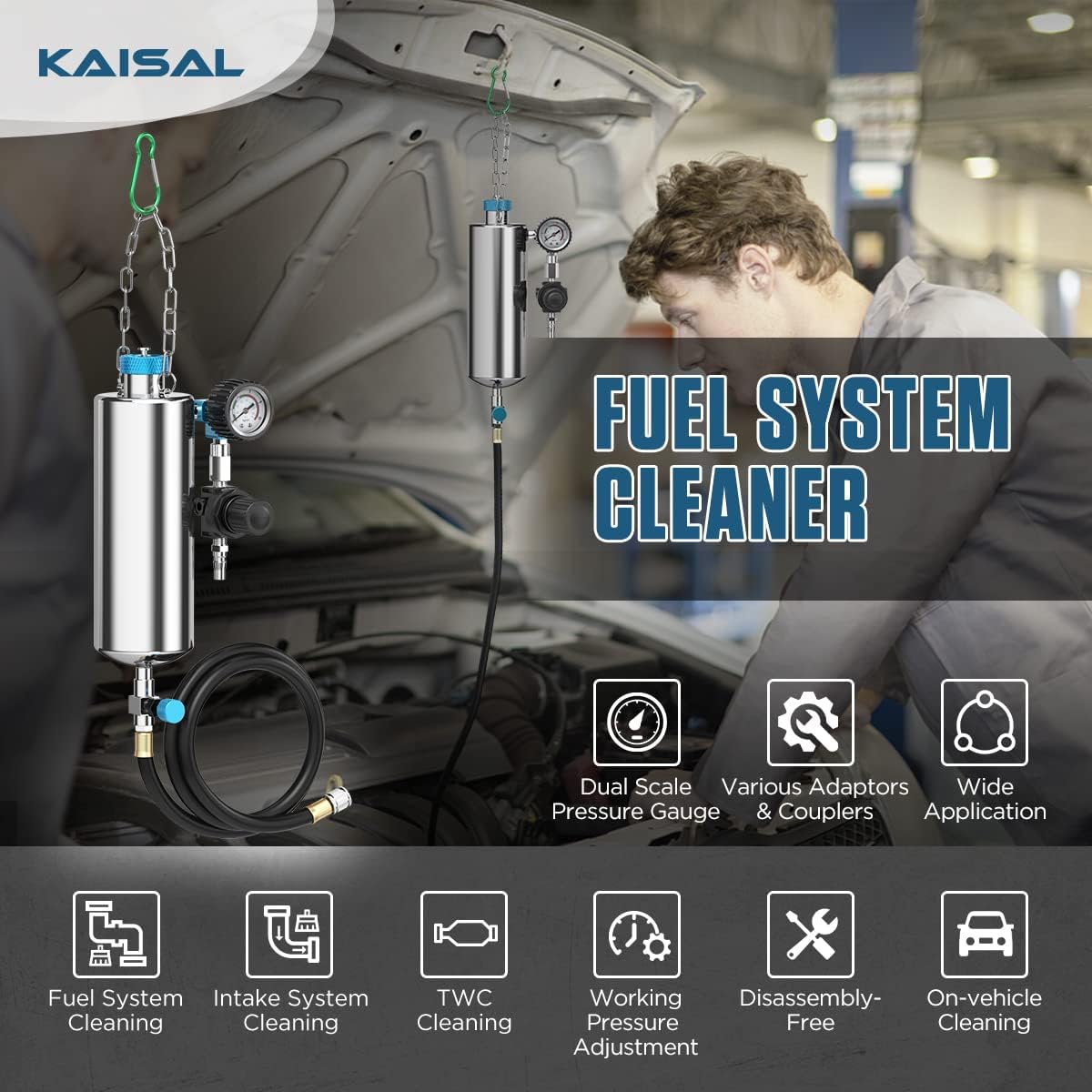
If your vehicle hesitates at idle, stumbles under light throttle, or is returning noticeably worse fuel economy than it used to, there’s a decent chance the fuel injectors — the small electrically controlled nozzles that spray atomized fuel into each cylinder — are partially clogged with varnish deposits. The traditional fix is a remove-and-replace (R&R) service: a technician pulls each injector out of the engine, runs it through an ultrasonic or flow-bench cleaning rig, and reinstalls it. That’s thorough, but it’s also time-intensive and can cost $200–$500 in labor alone on a four-cylinder. A non-dismantle fuel injector cleaning machine is the middle path — a pressurized canister-and-adapter kit that feeds concentrated cleaning solvent directly into the fuel rail while the engine runs, without removing a single injector. This guide covers exactly when that tool earns its $100–$200 price tag, when it doesn’t, and the one compatibility problem that trips up more buyers than anything else.
| EDITOR'S PICK[AUTOOL Fuel Injector Cleaner Ki…](https://www.amazon.com/dp/B0BLJP493W?tag=greenflower20-20) | Mid-tierEM276SET Fuel Injector Tester &… | Budget pick[LIQUI MOLY - DIJectron Additive…](https://www.amazon.com/dp/B0CDMW3557?tag=greenflower20-20) | |
|---|---|---|---|
| Pressure | 150PSI | — | — |
| Tank Capacity | 1000ML | — | — |
| Cleaning Method | Tester/Flush | Tester/Flush | Additive |
| Direct Injection Compatible | — | — | ✓ |
| Price | $79.99 | $28.49 | $21.00 |
| See on Amazon → | See on Amazon → | See on Amazon → |
What the Tool Actually Does (and What It Doesn’t Touch)
A non-dismantle kit connects to your vehicle’s fuel rail test port — a small Schrader valve, essentially the same type of valve stem you’d find on a tire — and delivers solvent under regulated pressure while the engine runs on that solvent alone, with the factory fuel pump disabled or bypassed. The cleaning chemistry circulates through the rail, enters the injectors under normal operating pressure, and exits as atomized mist into the combustion chamber, where residues burn off.
The mechanism is sound. SAE International’s technical paper archive on fuel injector deposit formation documents that light-to-moderate varnish deposits — the hydrocarbon lacquers that build up on injector pintles and needle seats over 30,000–80,000 miles of normal use — respond well to concentrated solvent soak-and-flush protocols. The operative word is “light-to-moderate.” An ASE Master Technician cited across multiple professional reviewer discussions of non-dismantle kits puts the realistic success rate at approximately 80% injector restoration when a quality solvent is used, but explicitly qualifies that figure: the 80% applies to injectors with performance-robbing but not mechanically destructive deposits. Injectors with worn solenoids, cracked pintle caps, or physical spray-pattern damage are not candidates for any cleaning service — they need replacement.
What the tool categorically cannot address:
- GDI intake valve carbon — In gasoline direct injection (GDI) engines, fuel is injected directly into the combustion chamber rather than the intake port. That means the intake valves never get a fuel bath, and combustion blow-by bakes a carbon crust on their backs that no injector cleaning service — dismantle or non-dismantle — can reach. Motor Age’s technical coverage of GDI carbon service is unambiguous: walnut blasting or chemical induction cleaning of the intake tract is the appropriate service for that problem, not injector cleaning.
- Injectors that are electrically failed — If a cylinder is misfiring because the injector solenoid has failed open or closed, solvent won’t fix it.
- Severely restricted injectors — Flow-bench testing at a dedicated injector cleaning shop can quantify flow rate before and after. If an injector is flowing less than 80–85% of rated volume, professional ultrasonic cleaning or replacement is the more reliable path.
Popular Mechanics’ explainer on fuel injector function describes the precision tolerances involved — injector orifice diameters measured in microns — which is useful context for understanding why even a partial deposit matters and why “good enough” cleaning has a real ceiling.
The Adapter Compatibility Problem Is the Whole Ballgame
Across aggregated buyer reviews of non-dismantle kits in the $100–$200 tier, adapter fitment is by far the most common failure point. Not pressure output. Not solvent incompatibility. Adapters.
Here’s the clearest real-world illustration, drawn from documented buyer feedback: one reviewer reports a completely successful treatment on a Chevy Trailblazer — the adapter seated, pressure held, the procedure ran cleanly. The same reviewer then attempts the same kit on a Honda Civic and cannot achieve a leak-free connection to the fuel rail port. Different port geometry, different adapter required, kit not supplied with it.
This is not a corner case. It’s the dominant complaint pattern. Fuel rail test ports are not standardized across manufacturers the way, say, OBD-II ports are. GM, Ford, Toyota, Honda, and European platforms each have their own port geometry conventions, and within each manufacturer there are generational variations. A kit marketed as “universal” may genuinely cover 70–80% of domestic applications from the 2000s–2010s and leave you stranded on a 2018 Accord or a 2020 Jetta.
Before you purchase any non-dismantle kit:
- Identify your vehicle’s fuel rail port type. This usually requires looking up the service manual section for fuel system pressure testing — the same port is used for fuel pressure gauge attachment, so information is findable.
- Cross-reference that port type against the specific adapter list in the kit’s documentation. Manufacturer product pages and Amazon listing Q&A sections often contain this information; check both.
- If your vehicle doesn’t have a Schrader-type test port at all — some returnless fuel systems and many GDI platforms do not — a non-dismantle kit cannot be used without a fuel rail adapter installed as a separate step, which is a different level of service entirely.
Underhood Service’s editorial coverage of fuel system diagnostics notes that many technicians keep a supplemental adapter set specifically because no single kit covers every application in a mixed bay.
Solvent Choice: What Actually Goes in the Canister
Buyers consistently ask about this, and the answer matters more than most kit marketing copy acknowledges.
The solvent has to accomplish three things simultaneously: dissolve varnish deposits, remain compatible with injector internals (rubber O-rings, plastic components), and combust cleanly enough that it doesn’t foul plugs or sensors during the procedure. Not every aerosol labeled “cleaner” qualifies.
Two solvent recommendations appear repeatedly in professional reviewer discussions of non-dismantle kits:
Berryman B-12 Chemtool is explicitly recommended by name in practitioner reviews as a proven, compatible choice for non-dismantle procedures. Its formulation is aggressive enough to cut varnish deposits without the residue concerns associated with heavier petroleum distillate products.
Carb cleaner aerosol cans are the other common recommendation — but with a specific physical caveat that at least one reviewer flags directly: you need cans with a wider tip compatible with the kit’s adapter interface. Standard narrow-straw aerosol tips often don’t seat correctly on the canister fill port. Check tip diameter against your kit’s specs before you buy by the case.
What about PEA (polyether amine) fuel additives — the active chemistry behind concentrated tank additives like Chevron Techron Concentrate Plus and BG 44K? PEA is highly effective at dissolving injector deposits and is the preferred chemistry for professional injector cleaning chemistry, but PEA-based additives are formulated for dilution in a fuel tank, not for full-concentration delivery through a pressurized canister at operating temperatures. The practical answer: use a purpose-formulated injector flush solvent for the non-dismantle procedure; PEA additives belong in the tank as a follow-up maintenance step.
Quality Control Signal: The CMTOOL Regulator Report
One specific quality-control data point worth flagging without overstating: at least one documented reviewer of a CMTOOL-branded non-dismantle kit reports regulator failure — the pressure regulator component breaking during use. This is a single reported incident, not a confirmed pattern across multiple units, and it does not indicate the category is unreliable. But it is a signal that in this price tier, build quality varies meaningfully between manufacturers, and the regulator — which controls the pressure delivered to the fuel rail — is a safety-relevant component. Buying from a brand with a documented return/replacement policy and verifiable customer service contact matters here in a way it wouldn’t for a simple hand tool.
The Economics: Where Non-Dismantle Makes Sense and Where It Doesn’t
By the numbers:
| Service path | Typical cost | Injectors accessible? | GDI valve carbon addressed? |
|---|---|---|---|
| Non-dismantle kit (one-time purchase) | $100–$200 | No R&R required | No |
| Professional ultrasonic clean (per set) | $150–$400 shop labor + parts | Full access, flow-tested | No |
| Walnut blast (GDI intake valves) | $300–$600 | Intake manifold removed | Yes |
| Injector replacement (4-cyl set) | $400–$1,200+ | Full access | No |
The non-dismantle kit’s economic case is strongest in two scenarios:
Preventive maintenance on a port-injected (PFI) engine with no active misfire. If you’re at 60,000 miles on a naturally aspirated port-injected four or six-cylinder, using the kit as a scheduled flush before deposits become symptomatic is exactly what it’s designed for. Cost per treatment, amortized over the kit’s useful life, is well under $30 including solvent.
Diagnostic triage before committing to professional service. If a vehicle presents with mild idle roughness and you want to rule out injector deposits before recommending ultrasonic cleaning or replacement, a non-dismantle flush is a defensible first step. If symptoms resolve, you’ve saved a customer a $300 service. If they don’t, you have a cleaner injector baseline and a stronger case for escalation.
Frequently Asked Questions
Do you need to remove injectors from the engine to use a non-dismantle cleaning kit? No — that’s the defining feature of the category. The kit connects to the fuel rail’s pressure test port (Schrader valve) and delivers solvent while the engine runs, leaving the injectors installed.
How do you know if your vehicle’s fuel rail has a compatible pressure port for these kits? Look up the fuel system pressure testing procedure in your vehicle’s service manual. If a fuel pressure gauge can be connected to test rail pressure, your vehicle has the port type these kits target. The port location and thread/stem geometry should be listed there. Cross-reference that geometry against the specific adapter list for any kit you’re considering before buying.
What cleaning fluid should you use — carb cleaner, PEA additive, or something else? Purpose-formulated injector flush solvent is the professional default. Berryman B-12 Chemtool is specifically named by experienced reviewers as a reliable compatible choice. If using aerosol carb cleaner, verify the can’s tip width fits your kit’s adapter — one reviewer notes that standard narrow-straw cans often don’t interface correctly. PEA-based tank additives are not appropriate for direct canister use at full concentration; use them in the fuel tank as a follow-up maintenance step.
Can a non-dismantle clean substitute for walnut blasting on a GDI engine with heavy carbon buildup? No. Non-dismantle injector cleaning addresses deposits on the injector itself — it does not reach intake valve carbon on GDI engines, because GDI injectors bypass the intake tract entirely. For GDI intake valve carbon, walnut blasting or chemical induction cleaning with the intake manifold removed is required. Per Motor Age’s GDI service coverage, these are distinct problems requiring distinct service procedures.
How do you verify the injectors are actually cleaner after the treatment if you can’t see them? The practical verification is functional: compare fuel trim data (short-term and long-term fuel trim, readable via OBD-II scan tool) before and after the procedure. Injectors that are delivering fuel more efficiently will shift fuel trims toward zero. A cylinder balance test — measuring contribution of each cylinder at idle — can also reveal a cylinder that was underperforming before the clean and improved after. You won’t have flow-bench numbers, but scan data gives you a real-world before/after comparison that’s honest and documentable.
The Decision Rule
If your vehicle is port-injected, has an accessible Schrader test port on the fuel rail, and is showing mild performance symptoms or is due for preventive maintenance, a non-dismantle kit is a rational $100–$200 investment — provided you’ve confirmed adapter compatibility before purchase, not after.
If your vehicle is a GDI platform with carbon symptoms, if the fuel rail has no test port, if you’re dealing with an active misfire code, or if adapter compatibility research comes up inconclusive, escalate to professional ultrasonic cleaning or dedicated GDI service. The non-dismantle kit is a precision tool for a specific problem — and like any precision tool, its value depends entirely on using it within its design envelope.