August 18, 2026 • Dale Merrick • 11 min reading time • Prices verified June 5, 2026
Liqui Moly Fuel Additives for European Cars: Jectron, Valve Clean, DIJectron, and Pro-Line Ranked
If you’ve ever stood in an auto parts store staring at a shelf full of brightly labeled bottles and wondered which one actually does something useful for your BMW, Audi, or Volkswagen, you’re in the right place. Fuel additives — liquids you pour into your gas tank or spray directly into engine components — work by dissolving carbon deposits and varnish buildup that accumulate over time and reduce how well your engine runs. The problem with Liqui Moly’s lineup in particular is that the brand sells several products that look similar on the shelf but target completely different parts of your fuel system. Picking the wrong one doesn’t just waste money — it can miss the actual problem entirely. This guide ranks four of their most relevant products for European vehicle owners, explains exactly what each one does and doesn’t do, and gives you a clear decision rule at the end so you leave knowing which bottle to buy.
Why Liqui Moly Has Outsized Credibility With European Car Owners
Liqui Moly’s position in this market isn’t accidental. The brand holds documented OEM approvals and technical release numbers from BMW, Mercedes-Benz, Volkswagen, and Porsche — a detail that matters enormously to independent shops and enthusiasts maintaining European vehicles to spec. Underhood Service’s import-vehicle fuel service overview notes that chemistry compatibility with tight-tolerance European injectors is a genuine differentiator, not just marketing language. When a shop is servicing a 2.0 TFSI or an N55 with a known injector-fouling TSB (technical service bulletin — a manufacturer’s official notice of a documented problem), reaching for a brand with an OEM-adjacent chemistry pedigree is a defensible professional choice.
The brand’s cross-platform trust is also notable in owner reviews. A single Pro-Line Gasoline System Cleaner user who documented results across a Mercedes ML350, a Hyundai Elantra, and a Lexus RX350 simultaneously is emblematic of how Liqui Moly has built credibility outside the European-car bubble. That’s useful context: these products aren’t German-engine-exclusive. But the OEM chemistry alignment is most directly relevant when you’re maintaining a platform with documented injector sensitivity.
The Core Four: What Each Product Actually Targets
Understanding the lineup requires understanding your engine’s fuel delivery architecture first — because that’s the single variable that determines which product belongs in your cart.
Port injection engines (most pre-2010 European cars, many current naturally aspirated engines) spray fuel upstream of the intake valves. Cleaners added to the fuel tank can reach the intake valves in these engines because fuel washes over them on the way in.
Gasoline direct injection (GDI) engines (most modern turbocharged European engines — 2.0T, 3.0T, N20, N55, EA888, M256, etc.) spray fuel directly into the cylinder, bypassing the intake valves entirely. This is the root cause of the GDI carbon problem: oil vapors from the PCV (positive crankcase ventilation) system coat the intake valves, and since no fuel ever washes over them, the deposits accumulate unchecked. Fuel-tank additives literally cannot reach these deposits. SAE paper 2019-01-0037 on GDI deposit formation confirms this mechanism in detail.
With that framing in place, here’s how the four products rank:
1. Liqui Moly DIJectron — Best for Modern GDI and Turbocharged European Engines
Rank: #1 for GDI platforms. Not a substitute for the others on port-injection cars.
DIJectron is specifically formulated for direct-injection engines. Unlike Jectron — which delivers cleaning chemistry via the fuel — DIJectron is designed to address the GDI carbon problem through a different delivery mechanism. Owner accounts in aggregated reviews describe meaningful results on platforms like the 3.3-liter twin-turbo (one reviewer reported a 15–20 MPG improvement on that engine, which is the single most dramatic fuel economy claim across the Liqui Moly product dataset; it should be read as one owner’s outcome on one specific vehicle in one set of conditions, not a repeatable guarantee). More representative outcomes across reviews describe smoother idle, reduced stumble at cold start, and resolved hesitation under load — symptoms consistent with deposit interference at GDI injectors.
The Audi Q5 owner who tried multiple other Liqui Moly products without resolution before DIJectron worked is worth dwelling on. That’s not a coincidence — it’s a chemistry-architecture story. Port-injection cleaners delivered via fuel cannot reach GDI intake-valve deposits by design. When DIJectron addressed what the others didn’t, it confirmed that the deposit type and location mattered, not just the brand. If you’re maintaining a turbocharged EA888, N20, N55, or B58 engine, DIJectron belongs at the top of your shortlist.
By the numbers:
| Engine Type | Jectron (tank-add) | DIJectron | Valve Clean (tank-add) |
|---|---|---|---|
| Port injection | ✓ Reaches injectors + valves | Overkill | ✓ Reaches injectors + valves |
| GDI / direct injection | ✓ Reaches injectors only | ✓ Injectors + targeted GDI deposits | ✓ Injectors only |
| GDI intake valves | ✗ Cannot reach | ✓ Targeted | ✗ Cannot reach |
2. Liqui Moly Jectron — Best General Maintenance Pick for Port-Injected European Cars
Rank: #2 overall. The everyday workhorse for non-GDI engines.
Jectron is Liqui Moly’s flagship fuel-system injector cleaner — a PEA (polyetheramine, the detergent chemistry recognized as the most effective deposit-removing agent in fuel additives, per Popular Mechanics’ fuel system overview) and detergent-based formula delivered via the fuel tank. For port-injected engines — older BMWs, most naturally aspirated Volkswagen and Audi four-cylinders before the TFSI era, Mercedes inline-sixes — it delivers cleaning chemistry directly to the injectors and across the intake valves on every combustion cycle.
The VW-branded additive case is instructive here: a reviewer who resolved a lean fuel code — documented in a VW TSB as a known injector-fouling pattern caused by non-premium fuel use — used what is believed to be Jectron chemistry repackaged under a VW service label. Whether the OEM label version is chemically identical or uses a slightly modified spec is debated in owner forums, but the outcome data is consistent: Jectron-grade chemistry addresses the injector deposit pattern that triggers lean codes in these engines.
For high-mileage port-injected German cars, Jectron at a scheduled interval (every 3,000–5,000 miles as a maintenance dose) is the most cost-effective chemistry defense available short of professional ultrasonic injector cleaning.
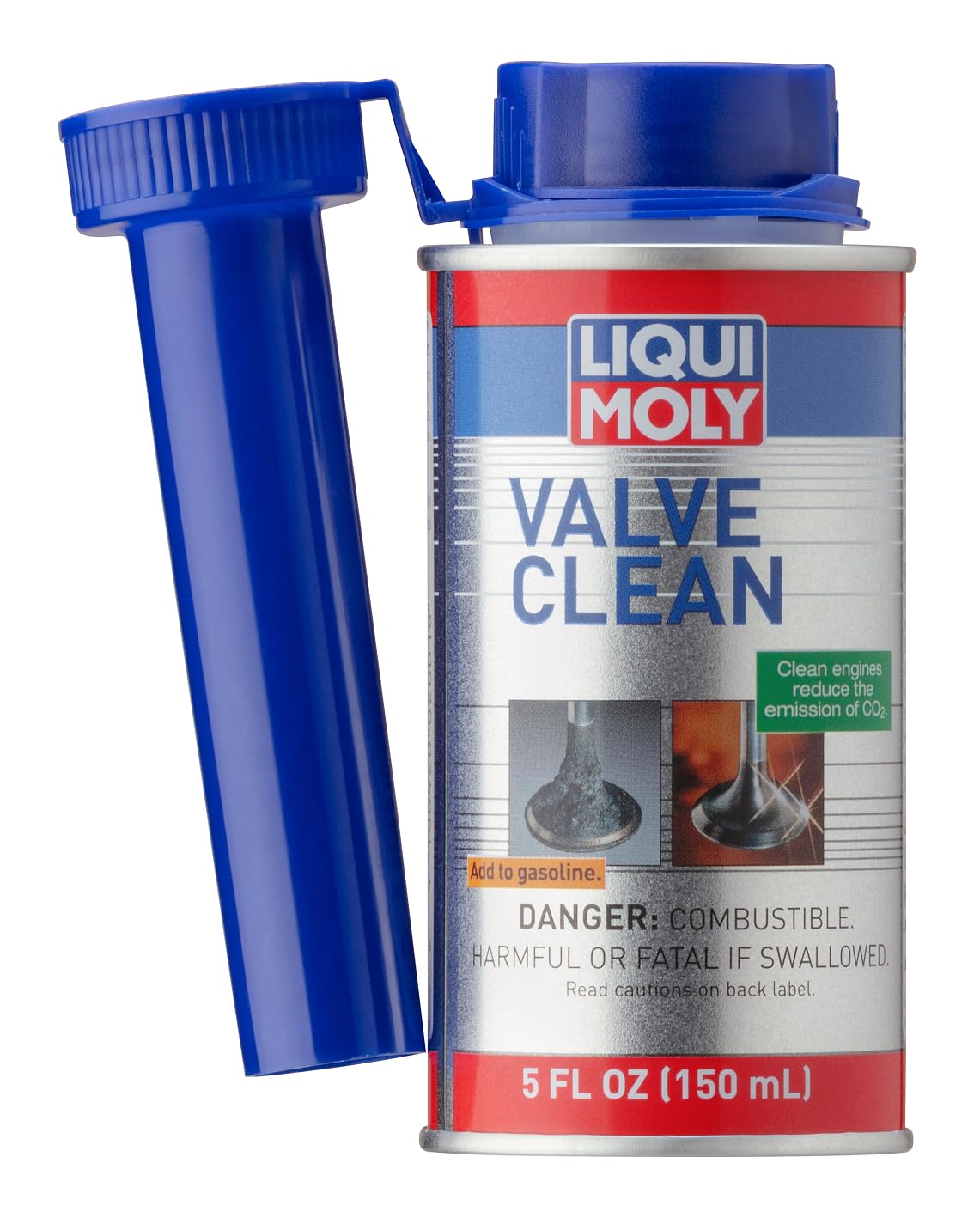
3. Liqui Moly Valve Clean — Best for High-Mileage Port-Injected Engines With Moderate Buildup
Rank: #3. Targeted at a specific deposit type; complements rather than replaces Jectron.
Valve Clean is formulated to address intake valve deposits specifically, and it’s most useful on port-injected engines that have accumulated meaningful carbon on the valve stems and heads — typically 60,000–100,000+ miles of PCV exposure without intervention. On a GDI engine, as the table above shows, it still cannot reach the intake valves via the fuel system, so its value on GDI platforms is limited to injector cleaning only (where Jectron or DIJectron are equally or more effective).
For a 100,000-mile BMW E46, an Audi A4 B7 with the port-injected 2.0, or a Mercedes C230 Kompressor, Valve Clean used on a 3–4 tank interval before walnut-blasting (the mechanical intake-valve cleaning procedure that physically removes carbon buildup) can reduce the severity of the job and improve between-service maintenance. On its own, it won’t eliminate heavy carbon — no fuel additive will. The honest position is that Valve Clean is a maintenance chemistry tool, not a corrective one at high buildup levels.
4. Pro-Line Throttle Valve Cleaner Spray — Narrow Use Case, High Value When Correct
Rank: #4 by versatility. #1 for its specific application.
Pro-Line Throttle Valve Cleaner is a direct-spray product — it’s not added to the fuel tank. You apply it directly to the throttle body (the valve that controls airflow into the engine) either through the intake with the engine off, or during a service with the air intake disconnected. Reviewers consistently describe excellent results cleaning throttle plate deposits, but they also consistently flag one detail the manufacturer instructions cover but that first-time users often skip: a throttle body adaptation reset is required after cleaning.
Modern drive-by-wire throttle systems (electronic throttle control, standard on essentially all post-2000 European cars) learn the exact position of the throttle plate at idle. When you clean the plate and remove the carbon layer that the ECU (engine control unit — the car’s main computer) has been compensating for, the learned position is now wrong. The result is rough idle, stalling, or erratic throttle response — which panics first-time users into thinking the product damaged something. It didn’t. A reset via OBD scanner or the manufacturer’s specified procedure (varies by platform; a 2019-model-year BMW procedure differs from a Volkswagen MQB procedure) corrects it immediately.
For independent shops servicing European cars with idle quality complaints or throttle response issues, Pro-Line Throttle Valve Cleaner is a legitimate service item — but it belongs in a workflow that includes the adaptation reset, not as a standalone spray-and-done.
Frequently Asked Questions
Is Liqui Moly DIJectron actually different from standard Jectron, or just repackaged? Meaningfully different. Jectron delivers PEA-based cleaning chemistry via the fuel stream, optimized for fuel injector deposits. DIJectron’s formulation targets the specific deposit chemistry found in GDI intake passages and is engineered to address areas and deposit types that fuel-delivered cleaners cannot reach. Liqui Moly’s own technical documentation treats them as distinct products with distinct application targets. The Audi Q5 owner data point — where Jectron failed and DIJectron succeeded — is real-world confirmation of that distinction.
Can I use Pro-Line Gasoline System Cleaner in a direct-injected engine even though it says port injection? The fuel-tank portion of Pro-Line Gasoline System Cleaner will reach and clean GDI fuel injectors, because those injectors are still supplied by the fuel system. What it cannot do is reach the intake valves on a GDI engine — no tank-added product can, because GDI fuel bypasses the valves entirely. If your concern is injector maintenance only, it’s usable. If you’re addressing GDI intake-valve carbon, DIJectron plus periodic walnut blasting is the appropriate protocol.
How often should I use Liqui Moly Valve Clean on a German car with 100K-plus miles? For a high-mileage port-injected European engine, a 3,000–5,000 mile service interval is the commonly cited maintenance dose. At 100,000-plus miles with no prior valve cleaning history, the first application should be understood as maintenance chemistry, not a corrective miracle — it will slow further buildup and may improve marginal symptoms, but significant existing deposits typically require mechanical cleaning (walnut blasting or professional service) to fully address.
Does the VW dealer-branded fuel additive use the same formula as Liqui Moly Jectron? The consensus among VW/Audi specialists and forum-documented disassembly comparisons strongly suggests the VW-branded additive uses Liqui Moly Jectron chemistry — the bottle designs, packaging language, and reported outcomes are nearly identical. Liqui Moly supplies OEM-adjacent products to several European manufacturers. Whether the exact spec is a 100% match or a minor variant is not publicly confirmed by either party, but the lean-code resolution outcome documented by the VW-branded additive user is consistent with what Jectron chemistry is documented to address.
Why do I need to reset the throttle body after using the Throttle Valve Cleaner spray? Drive-by-wire throttle systems store a learned idle position for the throttle plate. When carbon buildup is removed, the physical plate position changes relative to what the ECU expects. The computer hasn’t seen the clean plate before and continues commanding based on the old learned position. The result is idle instability or stalling — not product damage. A throttle body adaptation reset (performed via OBD diagnostic tool or the vehicle-specific key-cycle procedure) teaches the ECU the new baseline. This step is documented in Liqui Moly’s Pro-Line instructions and is platform-standard knowledge for any shop already running European diagnostics.
The Decision Rule
If X, then Y:
- GDI turbocharged European engine (EA888, N20, N55, B58, M256, etc.) → DIJectron for maintenance chemistry; add walnut blasting at 40,000–60,000 mile intervals for intake valves.
- Port-injected European engine, general maintenance → Jectron at 3,000–5,000 mile intervals.
- Port-injected engine, 80,000+ miles, carbon symptoms present → Valve Clean for 2–3 tank cycles, evaluate for professional service if symptoms persist.
- Idle quality complaint or throttle response issue on any European platform → Pro-Line Throttle Valve Cleaner as a service item, always paired with a throttle body adaptation reset.
- Unresolved lean fuel code on a VW/Audi with a known injector-fouling TSB → Jectron; the chemistry matches what the OEM-adjacent product addresses in documented cases.
The honest meta-point: Liqui Moly’s lineup is coherent, not redundant — but only if you match the product to the engine architecture. The shelf looks like four similar bottles. The engineering underneath is four different tools.