May 14, 2026 • Dale Merrick • 9 min reading time • Prices verified June 5, 2026
High-Mileage Fuel System Cleaners: Matching the Right Chemistry to Your Odometer
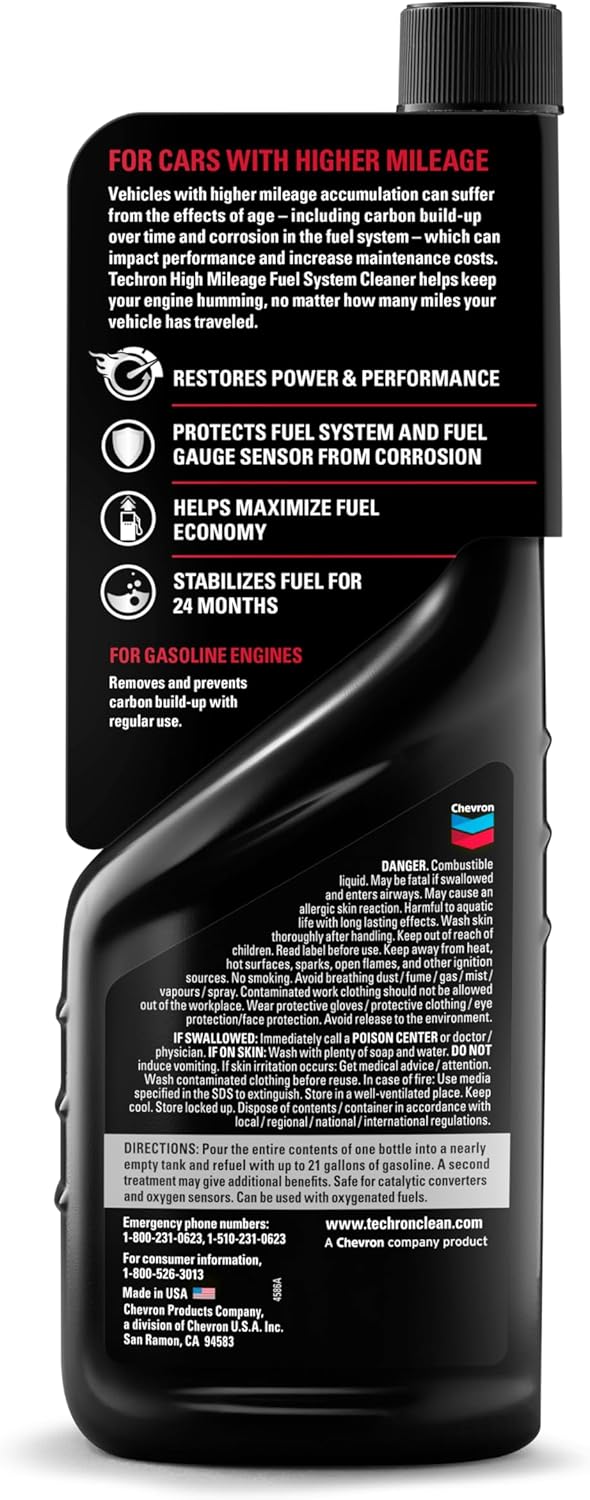
If your car has crossed the 75,000-mile mark and you’re thinking about a bottle of fuel system cleaner — the kind you pour into your gas tank to clean out the injectors (the small valves that spray fuel into each cylinder) and fuel passages — you’ve probably noticed the shelf at your auto parts store has about fifteen options all claiming to do the same thing. They don’t. The active chemistry differs quite a bit, and what works well on a relatively clean 30,000-mile engine can be either under-powered or genuinely risky on one that’s been accumulating deposits for a decade. This guide maps the chemistry to the mileage, so you walk out with the product that fits your engine’s actual condition — not just the one with the boldest label.
After the quick answer, we’ll layer in the technical why, show the cost math, and end with a clean decision framework you can apply to whatever’s sitting in your driveway right now.
Why Mileage Changes the Cleaning Equation
The core problem gets more complicated as the odometer climbs — but in different ways depending on how the engine was driven and maintained.
Port-injected engines (most vehicles built before ~2012) accumulate deposits primarily on the injector tips and intake ports at a gradual, predictable rate. At 30,000 miles those deposits are thin varnish. At 120,000 miles they can be hardened lacquer — a different cleaning challenge requiring either more concentrated chemistry or more time in contact with the deposit surface.
Direct-injected (GDI) engines add a layer of complexity that mileage makes worse. Because fuel is injected directly into the cylinder rather than past the intake valves, there’s no solvent wash keeping the back of the valve clean. Carbon accumulates on intake valves independent of fuel additive chemistry, since the additive never touches that surface. At 60,000–80,000 miles on a turbocharged GDI engine, owners and shop technicians routinely report rough cold-start idle and reduced throttle response that a tank-side cleaner alone can’t fully resolve. SAE Technical Paper 2019-01-0249 on GDI injector deposit formation documents how this deposit geometry differs from port-injection fouling and responds differently to solvent-based interventions.
The practical implication: at high mileage, you need to know your engine type before you buy a product, because the ceiling of what tank-poured chemistry can accomplish is different for each.
The Chemistry That Actually Moves the Needle: PEA vs. PIB vs. PIBA
Every fuel system cleaner is essentially a carrier fluid plus one or more detergent molecules. Three dominate the market:
PEA (polyether amine) is the industry’s most aggressive deposit solvent at in-use concentrations. Chevron’s internal technical bulletins on Techron technology credit PEA chemistry with measurable injector flow-restoration on fouled injectors. At high mileage, where deposits are older and more cross-linked, PEA concentration matters more than it does at lower mileage. Products with published-spec PEA content — Chevron Techron Concentrate Plus, BG 44K — are formulated at substantially higher treat rates than the broad-market options.
PIB (polyisobutylene) is a softer detergent effective on fresh varnish but documented in independent formulation comparisons as less capable against hardened high-mileage deposits. It’s the dominant chemistry in many value-tier products.
PIBA (polyisobutylene amine) lands between the two — stronger than straight PIB, weaker than PEA at equivalent concentration. Many mid-shelf products use PIBA blends.
The implication for high-mileage use is direct: PIB-dominant products are appropriate for maintenance on a clean, regularly-serviced engine; they are not the right tool for a 100,000-mile engine that’s never had a professional cleaning.
Mileage-Tier Decision Map
Here’s how to read the shelf based on where your odometer sits.
0–50,000 Miles: Maintenance Mode
At this mileage, deposit load is low in a well-maintained engine. PIB or PIBA chemistry at a standard treatment interval (every 3,000–5,000 miles, or once per oil change) is genuinely sufficient. Popular Mechanics’ overview of fuel injector cleaners notes that for newer engines, the goal is prevention rather than remediation — and prevention doesn’t require maximum-strength chemistry. Sea Foam Motor Treatment and Gumout Regane Complete Fuel System Cleaner are well-documented options at the $8–$12 price point. The cost math here is easy:
By the numbers — maintenance tier: Sea Foam (16 oz, ~$10) at one treatment per oil change =
$0.0033 per mile at 3,000-mile intervals. Chevron Techron Concentrate Plus ($18) at same interval = ~$0.006 per mile. Delta: ~$32/year on a 15,000-mile driver. Negligible. But at this mileage, the chemistry upgrade buys you nothing measurable.
50,000–100,000 Miles: The Crossover Zone
This is where product selection starts to matter. Deposit load is real but not yet calcified on most engines. PEA-based products at standard concentration begin outperforming PIB products in documented fleet testing.
For port-injected engines in this range, Chevron Techron Concentrate Plus or Lucas Fuel Treatment at a scheduled interval ($15–$22) represents the defensible middle ground — enough PEA concentration to address moderate varnish buildup without the cost premium of professional-tier chemistry.
For GDI engines entering this mileage tier: run a PEA-concentrate product every 5,000–7,500 miles, and if you’re seeing cold-start symptoms, add a throttle-body cleaning service — a separate physical cleaning, not a tank additive — to address intake valve deposits that tank-poured chemistry cannot reach. Car and Driver’s editorial overview of fuel injector cleaners makes this distinction clearly: the additive cleans what the fuel contacts; on GDI engines, the intake valves are upstream of the fuel spray and are not contacted.
100,000+ Miles: Remediation Chemistry
This is where the conversation changes. Owners in this mileage tier, particularly those with documented symptoms (rough idle, hesitation under load, reduced fuel economy), consistently report that value-tier chemistry produces no perceptible improvement. The deposit load simply exceeds what diluted PIB can dissolve on a single pass.
The high-mileage toolkit:
BG 44K ($60–$70 for a professional-volume can) is the documented benchmark here. BG Products’ own data sheet describes a high-concentration PEA formula intended for professional use and problem-engine remediation. Independent shop owners using BG Products service equipment report it as their go-to for customer vehicles presenting with injector-related symptoms at high mileage. At the per-treatment cost, it’s the most expensive tank-poured option — but the cost math against a shop injector cleaning service ($100–$200 labor) flips the calculation entirely.
Liqui-Moly Jectron occupies important territory for European-platform high-mileage vehicles. Liqui-Moly’s technical data sheet for Jectron documents OEM approvals including BMW and Volkswagen specifications — a non-trivial consideration for owners of late-model German vehicles where warranty-adjacent maintenance documentation matters. Reviewers of European vehicles consistently cite Jectron as the safe chemistry choice when staying within OEM-adjacent standards. For a 120,000-mile Audi A4 2.0T or BMW 328i, the combination of documented OEM approval and PEA-based chemistry makes it the defensible pick over domestic alternatives.
CRC GDI IVD Intake Valve & Turbo Cleaner addresses the GDI intake valve problem differently — it’s an aerosol induction cleaner applied through the intake, not a tank additive. At 100,000+ miles on any turbocharged GDI engine, operators consistently report that induction cleaning in combination with a tank-poured PEA product produces results that neither approach achieves alone. The mechanism is complementary: the induction cleaner physically contacts the intake valves; the tank additive addresses injector tips and combustion chamber deposits.
When Tank Chemistry Hits Its Ceiling
There’s an honest conversation to have here that the product labels won’t have with you: at some deposit load, no poured additive will fully restore injector flow. Published spec data from ultrasonic cleaning equipment manufacturers consistently shows that mechanically fouled injectors — those with calcified deposits or particle contamination in the needle seat — require physical cleaning or replacement regardless of chemical treatment.
Independent shops with ultrasonic injector cleaning rigs ($300–$2,000+ for professional equipment from Branson, Crest, or dedicated automotive-spec machines) can restore injector flow to within a few percent of OEM spec on most heavily-fouled injectors. For a high-mileage engine showing persistent fuel trim corrections (your scan tool will show long-term fuel trim values above ±10% as a flag), a physical injector clean or replace decision is worth pricing against the additive-cycle alternative.
The decision rule: if your scan tool shows long-term fuel trim corrections outside ±8–10% after two full tanks with a PEA-concentrate product, you’ve passed the threshold where poured chemistry is the appropriate tool.
The Sourcing Caveat for Premium Products
BG 44K and Liqui-Moly Jectron both carry documented counterfeit risk at third-party marketplace listings. BG Products distributes exclusively through authorized professional channels — service centers and professional supply accounts — and the company has published explicit warnings about marketplace counterfeits. Liqui-Moly products sold through unauthorized third-party sellers on major platforms have been flagged in enthusiast documentation as inconsistent with factory formulations.
For both products: buy from an authorized distributor or directly from a shop account. The cost delta between an authorized source and a third-party listing is typically small; the chemistry delta between authentic and counterfeit product is not.
The If/Then Decision Framework
| Condition | Chemistry Pick | Why |
|---|---|---|
| Port-injected, under 50K, no symptoms | PIB/PIBA maintenance product ($8–$12) | Prevention doesn’t need maximum chemistry |
| Port-injected, 50K–100K, mild symptoms | PEA concentrate, standard dose ($15–$22) | Moderate deposits respond to standard PEA |
| GDI, any mileage, cold-start roughness | PEA concentrate + induction cleaning | Tank additive + physical intake valve service |
| Any engine, 100K+, measurable symptoms | BG 44K or Liqui-Moly Jectron + PEA dose | High-concentration PEA for hardened deposits |
| European platform, OEM approval required | Liqui-Moly Jectron | Documented BMW/VW spec approvals |
| Scan tool shows fuel trims >±10% after treatment | Ultrasonic injector clean / shop service | Past the chemistry ceiling |
The honest summary: mileage is a proxy for deposit severity, not a guarantee of it. A 120,000-mile Honda maintained on regular chemistry from new presents differently than a 90,000-mile turbocharged GDI that spent its first five years on whatever was cheapest. The decision framework above uses mileage as the entry point, but symptoms and fuel trim data are the real arbiters once you’re in remediation territory.
Match the chemistry to the deposit load, not the odometer number — and when the deposits have outgrown what a bottle can solve, the ultrasonic cleaning bench is the honest next step.