May 9, 2026 • Dale Merrick • 9 min reading time • Prices verified June 5, 2026
GDI Carbon Buildup: Every Fix From a $9 Bottle to a $700 Ultrasonic Rig
If your car was built after roughly 2010 and has a turbocharged four-cylinder — think a VW Golf 2.0T, BMW 320i, Ford F-150 EcoBoost, or Subaru WRX — it almost certainly uses Gasoline Direct Injection, or GDI. In a traditional engine, fuel sprays onto the intake valves and rinses them clean on every cycle. In a GDI engine, fuel injects directly into the combustion chamber, bypassing the valves entirely. That sounds efficient (it is), but it also means oil mist and exhaust blowby bake onto those valves with nothing to wash them off. Over 30,000–80,000 miles, the buildup can look like a charred oyster shell. The result: rough idle, lost power, misfires, and a CEL you don’t want to explain to a customer. This guide maps every cleaning solution on the market — from a $9 bottle at the parts counter to a $700-plus ultrasonic bench rig — with honest cost math and a clear decision rule at each tier.
Why Fuel Additives Alone Can’t Solve the GDI Problem
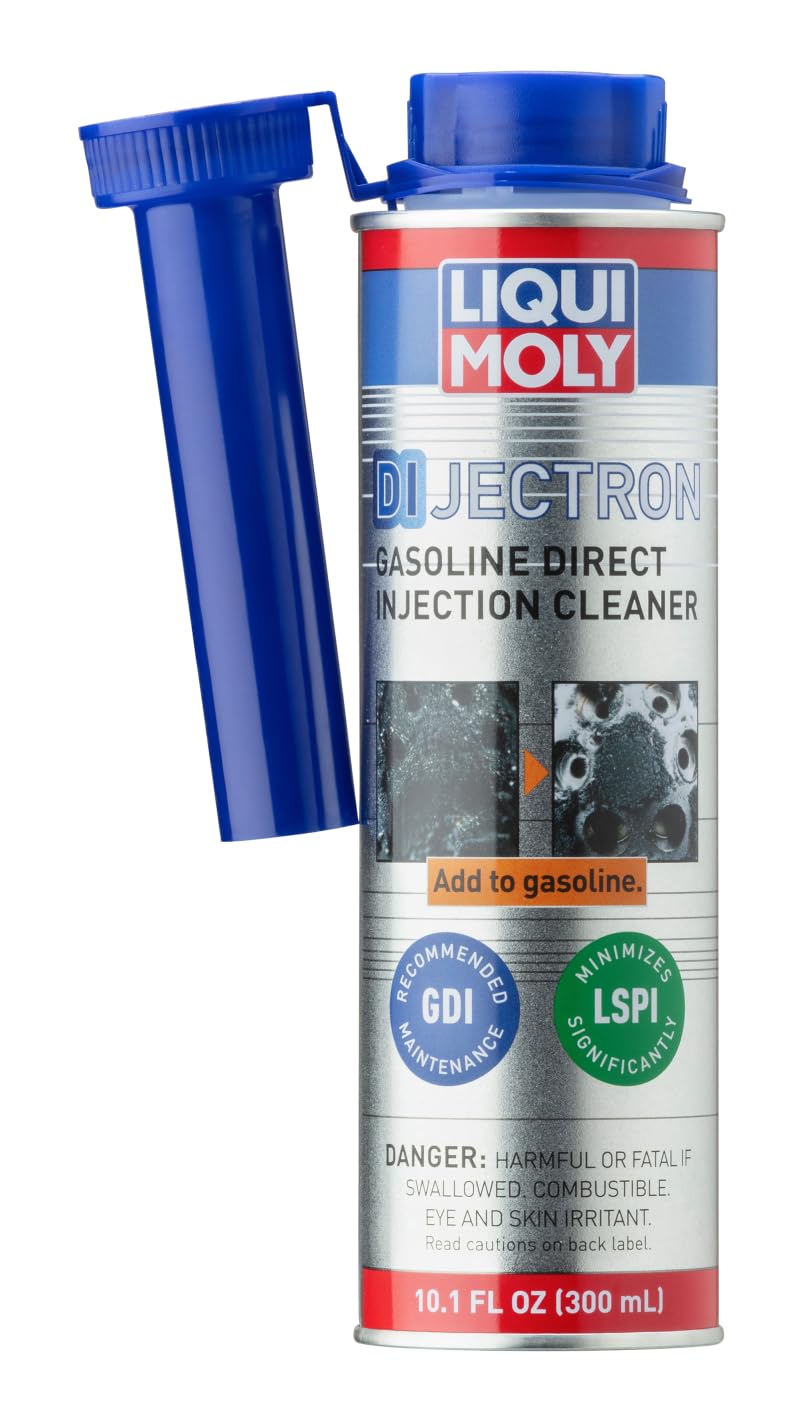
This is the central trade-off you need to internalize before spending a dollar. Fuel additives — PEA (polyether amine) chemistry products like Chevron Techron Concentrate Plus, BG 44K, and Liqui-Moly Jectron — work brilliantly in port-injected engines because the chemistry washes over the intake valves on every combustion event. In a GDI engine, the fuel never touches the intake valves at all. The additive goes straight into the combustion chamber and out the exhaust, mostly bypassing the exact surfaces where carbon accumulates.
SAE International’s technical paper 2013-01-0897 on GDI intake valve deposit mechanisms makes this point plainly: deposit formation on GDI intake valves is driven by oil mist and blowby condensation, not by fuel quality or detergency. The fuel additive pathway is structurally excluded from the problem surface.
That doesn’t make fuel additives useless on GDI engines — they clean fuel injectors, combustion chamber deposits, and oxygen sensors that degrade from combustion byproducts. But Popular Mechanics’ overview of direct-injection engine maintenance notes clearly that fuel-side chemistry has limited reach on valve deposits. Understand what you’re buying before you pour.
The honest tier map:
| Solution | Price Range | What It Cleans | GDI Valve Deposit Impact |
|---|---|---|---|
| Fuel additive (PEA) | $9–$65 | Injectors, combustion chamber | Minimal to none |
| Induction service spray | $20–$80 (parts) | Intake tract, valve faces | Moderate, surface-level |
| Walnut blasting (shop) | $250–$600 | Intake valves directly | High — removes deposits mechanically |
| Off-car ultrasonic clean | $0 labor (shop owns rig) | Injectors, some valve-adjacent | Injector-focused, not valve deposits |
Tier 1: The $9–$30 Fuel Additive — What It Actually Does on a GDI Engine
Let’s be fair to these products before dismissing them. On a GDI engine at moderate mileage (under 40,000 miles), a quality PEA additive run every 5,000–8,000 miles does three legitimate things:
1. Keeps injectors clean. GDI injectors operate at extremely high pressures (1,500–3,600 psi depending on the system) and are prone to tip coking. Chevron Oronite’s product data sheet for Techron Concentrate Plus documents effective injector deposit removal at the standard treat rate. BG Products’ bulletin for BG 44K specifies a one-tank treatment designed to restore injector spray patterns degraded by deposits.
2. Mitigates combustion chamber buildup. Carbon on piston crowns and combustion chamber walls does affect combustion efficiency. PEA chemistry reaches these surfaces and is documented to reduce those deposits over several treatment cycles.
3. Keeps you ahead of the curve. On engines under 30,000 miles that have been maintained with quality fuel, regular PEA use may slow the rate of valve deposit formation indirectly — not by cleaning the valves, but by keeping the combustion environment cleaner so blowby is less contaminated. This is prevention logic, not cure logic.
Cost math: Techron Concentrate Plus at $15 every 5,000 miles works out to roughly $0.003 per mile. BG 44K at $60 once a year (the most common shop-dispensed cadence) runs about $0.004 per mile on a 15,000-mile-a-year vehicle. These are legitimate costs against the combustion-side cleaning they provide.
The Liqui-Moly angle for European platforms: Liqui-Moly’s Jectron spec sheet lists OEM-adjacent approvals relevant to BMW and VW/Audi owners concerned about warranty compatibility. For the European-car reader, this chemistry overlap with OEM fluid standards matters. That said, the intake valve caveat applies equally to a BMW N20 or an Audi EA888.
Decision rule: If the engine is under 40,000 miles, has no symptoms, and you’re in prevention mode, a quality PEA additive on a 5,000–8,000 mile interval is the right call. It’s not the whole answer, but it’s not money wasted.
Tier 2: The $20–$80 Induction Service — The Middle Ground Worth Understanding
An induction cleaning service — typically an aerosol product sprayed into the intake tract while the engine idles, or through a vacuum line — is where the GDI carbon conversation gets more interesting. CRC Industries’ technical data sheet for the GDI IVD Intake Valve & Turbo Cleaner explicitly addresses this gap: the product is formulated as an induction-delivered solvent designed to reach intake valve surfaces through the air intake path rather than the fuel system.
This is a different delivery mechanism than a fuel additive, and it matters. Because the chemical enters through the intake, it contacts the valve faces during the intake stroke — the surface where carbon actually accumulates.
What shops charge vs. what it costs to DIY: A professional induction service with a quality product typically runs $100–$250 at an independent shop, primarily for labor and equipment (some shops use pressurized delivery systems). The CRC GDI IVD aerosol retails for around $20–$30 and can be applied with basic vacuum-line access, though technique affects results significantly.
Honest trade-off: Induction service chemistry softens and loosens deposits — it doesn’t mechanically remove them the way walnut blasting does. On engines with moderate buildup (40,000–80,000 miles, no severe symptoms), it can provide measurable improvement. On engines with heavy carbon (oyster-shell-level deposits on a high-mileage turbo four-cylinder), it’s treating a structural problem with a surface solution.
Decision rule: If you’re at 40,000–70,000 miles with mild symptoms (slight hesitation at cold start, modest power loss), an induction service is a reasonable first step before committing to the mechanical options. Run it, then reassess in 2,000–3,000 miles.
Tier 3: Walnut Blasting — The Only Real Solution for Heavy Deposits
Walnut blasting is the benchmark GDI carbon cleaning method recommended by BMW, Volkswagen, and Audi among others as the factory-endorsed procedure for intake valve cleaning on their GDI platforms. The process involves removing the intake manifold, masking the cylinder head, and using a media blaster loaded with crushed walnut shells to abrasively remove carbon deposits from valve faces and intake ports. The walnut media is soft enough not to damage valve seat or stem surfaces, but abrasive enough to remove even heavily baked-on carbon.
By the numbers:
- Typical shop labor: 3–5 hours on an inline-four GDI engine
- Flat-rate shop cost (2026 market): $350–$600 depending on platform and market
- BMW-recommended service interval (per BMW service documentation): every 30,000–45,000 miles on N-series engines
- Media cost for a shop performing this in-house: $15–$30 per vehicle in walnut shell media
This is the highest-impact cleaning available without removing the cylinder head. Independent shop owners who’ve built walnut blasting into their GDI service menus report it as a strong retention service — customers with these symptoms return predictably, and the per-ticket value is solid.
The equipment investment for shops: A dedicated media blasting setup capable of walnut blast work runs $400–$1,200 for entry-level commercial units. This is a different investment category than the ultrasonic rigs discussed below — walnut blasting targets valve deposits specifically, while ultrasonic cleaning targets injectors.
Decision rule: Engine over 60,000 miles with documented symptoms (rough idle, misfires P030x, loss of power on boost)? Walnut blasting is the first-line mechanical intervention. Don’t chase it with additives first — get a scope on the valves, confirm the buildup is severe, and proceed directly.
Tier 4: The Ultrasonic Injector Cleaning Rig — What It Does and Doesn’t Do in a GDI Context
Here’s where the practitioner-level distinction matters most. An ultrasonic injector cleaning machine — in the $300–$2,000 range from suppliers like Launch, Hartridge, or ASNU — is purpose-built to restore injector spray pattern, atomization, and flow rate by ultrasonically cleaning removed injectors in a solvent bath. On a GDI engine, this is a genuinely valuable service because GDI injectors operate under extreme conditions and are expensive to replace (often $150–$400 each).
What ultrasonic cleaning solves on GDI:
- Tip coking reducing spray cone quality
- Internal deposits degrading flow rate consistency across all cylinders
- Rubber component and seat deposits that throw off dynamic fuel delivery
What it doesn’t solve:
- Intake valve deposits — full stop. The injectors are downstream of the valves in the combustion chamber, not in the intake tract.
For a shop owner building a GDI service protocol, the right mental model is: walnut blasting and ultrasonic injector cleaning are complementary, not competing services. A high-mileage GDI engine with rough idle may need both — valve deposits causing hesitation, and injector tip coking creating uneven fueling. Running both services in the same visit is legitimate shop practice.
Cost math for shops: A $700 entry-level ultrasonic bench rig amortized over 100 injector cleaning jobs works out to $7 per job in equipment depreciation. At a shop rate of $25–$60 per injector cleaned, the margin case is straightforward on volume.
Decision rule for shop owners: If your market includes a meaningful density of GDI turbocharged vehicles (and in 2026, nearly every European and Japanese platform in your bay qualifies), the ultrasonic rig pays for itself relatively quickly on injector work alone. Add walnut blasting capability and you have a complete GDI carbon service that no parts-counter additive can replicate.
The Decision Framework in Plain Language
Match the fix to the mileage, symptoms, and role:
- Under 40,000 miles, no symptoms, prevention mindset: PEA fuel additive (Techron Concentrate Plus, BG 44K, or Liqui-Moly Jectron for European platforms) on a scheduled interval. Cheapest cost per mile, addresses combustion-side cleanliness.
- 40,000–70,000 miles, mild symptoms, testing the water: Induction service with a purpose-built GDI product like CRC GDI IVD. Moderate cost, moderate impact, good diagnostic step.
- 60,000+ miles, confirmed buildup, real symptoms: Walnut blasting. Don’t substitute additives for a mechanical fix at this stage. Budget $350–$600 and get it done.
- Shop owner building a GDI service menu: Ultrasonic rig for injectors plus walnut blasting capability for valves. These are complementary services with distinct customer-facing value. The additive sells prevention; the mechanical services sell restoration.
The carbon will build on every GDI engine in your bay. The question is whether you’re ahead of it or chasing it. Know which tier you’re in, and spend accordingly.