May 10, 2026 • Dale Merrick • 9 min reading time • Prices verified June 5, 2026
Fuel Stabilizers for Seasonal Storage: Ethanol Chemistry, Shelf Life Math, and the Right Bottle
If you’ve ever pulled a lawn mower out of the garage in April, cranked it a dozen times, and gotten nothing but a faint whiff of varnish, you’ve already met the problem this article solves. Gasoline isn’t stable the way motor oil is. Left in a tank or carb bowl for weeks — especially the ethanol-blended fuel that now makes up virtually all pump gas in the United States — it begins to oxidize, absorb atmospheric moisture, and deposit sticky gum and varnish on every surface it touches. A fuel stabilizer is a liquid additive you mix into the tank before storage; its job is to slow or stop that degradation chemistry and keep the fuel usable until next season. This guide explains which chemistry actually works, how long different products realistically extend fuel life, and how to match the right bottle to your engine type and storage window.
| EDITOR'S PICK[STAR BRITE Star Tron Enzyme Fue…](https://www.amazon.com/dp/B00D3IEIY0?tag=greenflower20-20) | Mid-tier[STA-BIL Storage Fuel Stabilizer](https://www.amazon.com/dp/B00NEG3CIO?tag=greenflower20-20) | Budget pick[STA-BIL 360 Protection Ethanol…](https://www.amazon.com/dp/B00NEG3CIO?tag=greenflower20-20) | |
|---|---|---|---|
| Treats up to | 512 Gal | 80 Gal | 5 Gal |
| Concentrated | ✓ | — | — |
| Storage duration | — | 24 months | — |
| Enzyme formula | ✓ | — | — |
| Price | $29.59 | $10.61 | $6.99 |
| See on Amazon → | See on Amazon → | See on Amazon → |
Why Ethanol Changes the Storage Equation Entirely
The U.S. Energy Information Administration’s reference page on fuel ethanol use notes that E10 (10% ethanol blended into gasoline) is now the standard retail blend at nearly every pump in the country, with E15 availability expanding in many markets as of 2025–2026. That matters enormously for storage, and here’s why.
Ethanol is hygroscopic — it actively pulls water vapor out of the air and holds it in suspension in the fuel. In a running engine that cycles fuel quickly, small amounts of absorbed moisture are harmless. In a stored tank over three to six months, the picture changes. Once ethanol absorbs enough water, it undergoes phase separation: the ethanol-water mixture drops out of solution and sinks to the bottom of the tank as a separate, corrosive layer. The gasoline floating above it is now fuel-lean on octane and oxidizer; the layer below it is essentially a water-alcohol mix that will destroy carb jets, injector tips, and aluminum fuel system components.
SAE Technical Paper 2012-01-1635 on ethanol blend oxidation in small engines documents accelerated varnish and gum formation timelines in E10 fuels versus pre-ethanol reference fuel, showing meaningful deposit increases beginning as early as 30 days in warm, humid storage conditions — the exact environment of a garage in late summer or early fall when many people make their last seasonal run before storage.
Untreated E10 in a vented, non-pressurized system (carbureted small engine, boat motor, ATV) has a practical shelf life of roughly 30–60 days before degradation becomes a service problem. Even in a sealed modern fuel-injected vehicle with a pressurized tank, most manufacturer guidance — including Yamaha Motor Corporation USA’s owner’s manual supplement series for marine applications — recommends treatment if the vehicle will sit longer than 30 days. The stabilizer’s job is to extend that window by interrupting the oxidation chain reaction and, in better formulations, displacing or binding the moisture before it can trigger phase separation.
What the Chemistry Actually Does (and What It Can’t)
Fuel stabilizer formulations vary, and the marketing language on bottles is not always honest about the mechanism. There are three things a stabilizer can do; no single product does all three equally well.
Antioxidant package (the baseline): Every stabilizer worth buying contains some form of antioxidant chemistry — typically hindered phenols or aromatic amines — that interrupt free-radical chain reactions in the fuel. Oxidation is what turns light gasoline fractions into the dark, gummy varnish that clogs jets and injectors. This is the mechanism that extends basic shelf life and is present in every major product including STA-BIL 360 Protection, PRI-G, and Royal Purple Max-Clean formulations.
Corrosion inhibitors: Metal surfaces in fuel systems — particularly the zinc and aluminum alloys common in carburetors and the mild steel of older fuel tanks — are vulnerable to the acidic byproducts of ethanol oxidation. Quality stabilizers add a corrosion inhibitor film to wet metal surfaces. This is where products positioned specifically for ethanol (STA-BIL’s “360” line, Star Tron Enzyme Fuel Treatment) differentiate from older formulations.
Demulsifiers and moisture dispersants: Some formulations include chemistry designed to disperse small amounts of absorbed water back into the fuel as a combustible emulsion rather than allowing it to phase-separate. This is the mechanism Star Tron’s enzyme-based marketing leans on, and it is the most variable claim in the category — effective at low moisture levels, largely ineffective once significant phase separation has already occurred. Popular Mechanics’ staff feature on small engine winterization notes that no additive can reverse phase separation once it has occurred; the fuel must be drained and replaced at that point.
What no stabilizer can do: Restore already-degraded fuel, undo phase separation, or protect a tank that was stored partially empty (air volume accelerates oxidation; full tanks store better). These are limits worth stating plainly.
Shelf Life Math: How Long Does Each Approach Buy You?
The honest answer is that “up to 24 months” on a bottle label reflects a best-case scenario: sealed container, treated immediately after purchase, stored in moderate temperatures. Real-world storage in a vented carbureted system in a warm climate shortens that meaningfully. Here’s a working framework:
By the Numbers — Practical Treated-Fuel Shelf Life Windows
| Scenario | Untreated | Standard Stabilizer (STA-BIL 360, Briggs & Stratton) | High-Concentration / PRI-G / Marine Grade |
|---|---|---|---|
| Carbureted small engine, vented tank, warm storage | 30–60 days | 6–12 months | 12–24 months |
| Fuel-injected vehicle, pressurized sealed tank | 60–90 days | 12–18 months | 18–24 months |
| Marine/outboard, seasonal (6–8 month layup) | 30–45 days | 8–12 months | 12–24 months |
| Diesel (no ethanol, different degradation mechanism) | 6–12 months | 12–18 months | 24+ months |
Ranges based on manufacturer-rated claims cross-referenced against aggregated owner reports and marine industry service guidance. Actual results vary with temperature, tank geometry, and fuel quality at fill-up.
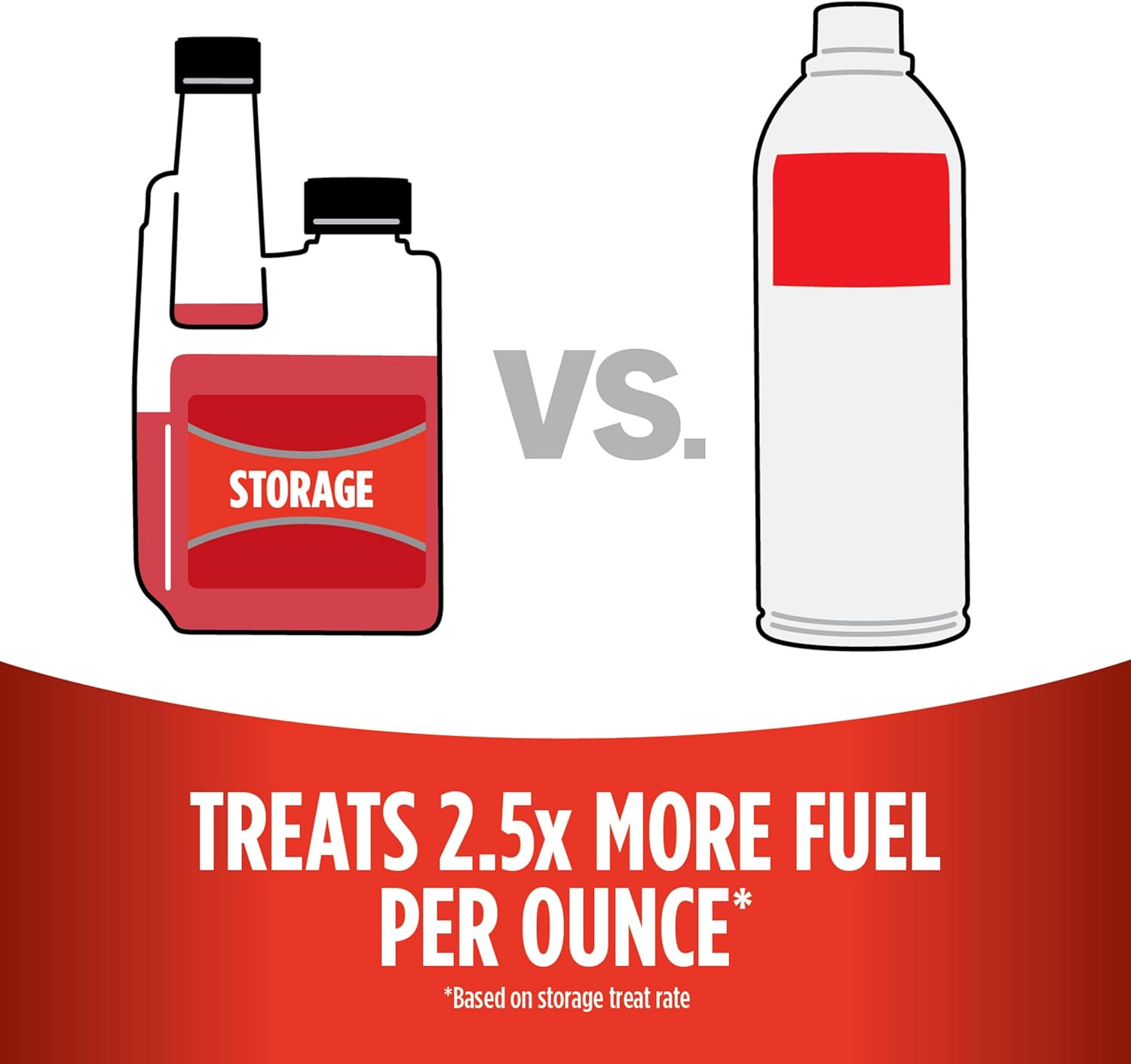
The cost math is a non-issue. A 32 oz bottle of STA-BIL 360 Protection treats up to 80 gallons at standard dose and retails in the $12–$16 range as of mid-2026. PRI-G, a fuel stabilizer with a loyal following among generator-prep communities and long-term storage users, runs approximately $20–$25 for a 16 oz bottle that treats 256 gallons at maintenance dose. Per-gallon treatment cost for either product is measured in single-digit cents. The question is never cost — it’s matching the product’s mechanism to your actual storage window and tank type.
Matching the Right Product to Your Engine and Timeline
This is the decision frame that the shelf will not give you, because every product’s marketing copy claims the widest possible use case.
Carbureted small engines (mowers, tillers, generators, older motorcycles): This is the highest-risk category because the carb bowl holds a small volume of fuel exposed to maximum air contact and heat cycles. The correct protocol per the EPA’s Renewable Fuel Standard documentation context — and echoed in virtually every OEM small-engine guide — is to run the engine until the carb bowl is empty after adding stabilizer to the main tank. You want treated fuel through the entire system, not just the tank. STA-BIL 360 Protection is the default recommendation here; it has documented ethanol-specific inhibitor chemistry and is widely available at every auto parts and home improvement chain. For a 90-day storage window, it’s more than adequate.
Marine outboards (6–8 month winter layup): Outboards combine the worst traits: ethanol fuel, vented fuel systems, temperature cycling, and long storage durations. Marine-specific formulations like Star Tron Enzyme Fuel Treatment and STA-BIL Marine are formulated for this environment. Yamaha Motor Corporation USA’s storage supplement documentation recommends treating fuel, fogging cylinder walls separately, and running the engine to circulate treated fuel — the stabilizer is one step in a multi-step protocol, not the whole answer.
Modern fuel-injected daily drivers stored 30–90 days: A pressurized sealed fuel system in a modern car is the most forgiving scenario. Standard STA-BIL or a single dose of a PEA-containing fuel system cleaner (Chevron Techron Concentrate Plus covers both cleaning and light stabilization during short-term storage) is sufficient for a seasonal vehicle laid up for 60–90 days. For longer windows, move to a dedicated high-concentration stabilizer.
Diesel applications: Diesel degrades via a different mechanism — microbial growth and oxidative breakdown of paraffin fractions — rather than ethanol phase separation. Products like Sta-Bil Diesel or Power Service Diesel 911 address diesel-specific concerns. Standard gasoline stabilizers offer limited benefit on diesel.
Performance vehicles and classics with E0 fuel (ethanol-free): Ethanol-free premium fuel is available at some marine/aviation outlets and premium pumps in select markets. If you can source E0, the storage chemistry problem simplifies substantially: no phase separation risk, slower oxidation baseline. A standard antioxidant stabilizer is sufficient for 12+ month storage windows. For irreplaceable classics, the premium of E0 fuel plus PRI-G is the documented preference among long-term collector car storage communities, and the reasoning is sound.
The Decision Rule
If the storage window is under 90 days and the tank is sealed/pressurized: treat with any name-brand stabilizer at label dose, fill the tank to 90%+ to minimize air volume, and call it done.
If the storage window is 3–8 months, the system is carbureted, or you’re dealing with a marine application: use an ethanol-specific formulation (STA-BIL 360 or equivalent), run the engine to circulate treated fuel through the carb, and fill the tank. Consider a fuel-system stabilizer with corrosion inhibitor chemistry, not just an antioxidant-only product.
If the storage window is over 8 months or you’re managing a generator or equipment where failure-to-start has real consequences (emergency preparedness, seasonal business operations): PRI-G or a marine-grade high-concentration stabilizer is the correct tier. Document the treatment date, and re-treat if the fuel is held longer than the product’s rated window.
One rule applies in every scenario: Treat fuel that is as fresh as possible. Stabilizers interrupt degradation — they do not reverse it. Adding STA-BIL to fuel that already smells slightly stale is better than nothing, but adding it to fresh fuel the day of fill-up is where the chemistry performs as advertised.
The shelf life math is simple. The chemistry decisions are straightforward once you separate ethanol moisture management from basic antioxidant protection. The right bottle is whichever one you actually use before you park the machine for the season, not the one still sitting on the workbench in April.