August 21, 2026 • Dale Merrick • 11 min reading time • Prices verified June 5, 2026
Fuel Injector Tester Kits for Home Mechanics: $22 Pulse Tools to $130 Dual-Channel Rigs

A fuel injector is essentially a precision solenoid valve — an electrically controlled nozzle that sprays a measured pulse of fuel into your engine dozens of times per second. When one goes lazy, clogged, or fully dead, your engine misfires, burns more fuel, and throws codes. The expensive fix is a shop visit with a lab-quality flow bench. The smarter first move for a home mechanic is a bench tester kit: a device that sends a timed electrical pulse to the injector (making it click open and closed), lets you watch the spray pattern, and in many configurations lets you push solvent through the nozzle to dissolve varnish deposits. These kits run from roughly $22 for a single-injector pulse tool all the way to $130 for dual-channel rigs with variable frequency controls. This guide maps the product landscape honestly — what each tier actually does, where the real-world limitations are, and which kit matches your situation.
| EDITOR'S PICKAUTOOL Fuel Injector Cleaner Ki… | Mid-tierEM276SET Fuel Injector Tester &… | Budget pickUniversal Fuel Injector Tester… | |
|---|---|---|---|
| Pulse Modes | — | — | 8 |
| Channel Config | — | — | 4-wire dual |
| Adapter Sizes | — | — | 8 sizes |
| Output Voltage | — | — | 12V/5V |
| Cleaner Capacity | 1000ML | — | — |
| Pressure Rating | 150PSI | — | — |
| Price | $79.99 | $28.49 | $26.89 |
| See on Amazon → | See on Amazon → | See on Amazon → |
The Two Jobs Every Injector Tester Has to Do
Before you compare price tiers, get clear on which job you are actually hiring this tool for. These kits are built around two distinct use cases, and they are not equally good at both.
Job 1: Diagnosis. You want to know whether an injector is dead, weak, or fine. A dead injector will not click at all when pulsed. A weak one clicks but delivers reduced flow. A healthy one clicks cleanly and — if you are doing a bench spray test — produces a symmetrical cone pattern. As Motor Magazine’s “Fuel System Diagnostics: From Code to Cure” (motor.com) describes in its diagnostic workflow, confirming electrical operation is always step one. Before you condemn an injector on drop-cylinder data alone, you need to know whether it is opening at all.
Job 2: Cleaning. You pulse the injector repeatedly while solvent flows through it — usually by connecting the injector’s inlet to a pressurized can of carburetor cleaner. The mechanical hammering of the solenoid opening and closing, combined with the solvent flush, breaks up varnish and gum deposits that restrict flow.
The key tradeoff: budget pulse tools handle Job 1 tolerably and Job 2 conditionally. Mid-range kits with variable frequency and pressure do both jobs well. The non-dismantle kits add a third job — cleaning injectors while they are still mounted in the engine — at the cost of more setup complexity.
Comparing the Three Tiers of Home Injector Tester Kits
Tier 1 — The $22–$45 Pulse Tool (EM276-Style Kits)
The EM276 and its near-identical siblings represent the entry point. You get a pulse generator unit, leads that clip to a 12V battery, a set of injector adapters, and a trigger button. Plug the adapter into your injector, hold it over a clear graduated cup, press the trigger, and count pulses. Each click you hear is the injector opening and closing. No click means a dead solenoid. A click but no spray means a mechanically stuck nozzle.
The carb-can adapter issue you need to know about. Multiple owners flag that the cleaning adapter — the piece that threads onto a pressurized carb cleaner can — is not universally compatible. The can head geometry on aerosol products varies. Berryman B-12 Chemtool is the can style most often named as seating correctly in the standard EM276 adapter. If you arrive with a different brand’s can and the threads do not engage, you are not cleaning anything. Buy the correct can before your service day, not after.
What this tier cannot tell you. A basic pulse tool tells you open or closed — it does not quantify flow rate. SAE International Technical Paper 2019-01-0249, “Fuel Injector Flow Variation and Its Effect on Mixture Uniformity” (sae.org), documents that injector-to-injector flow spread of even 5–8% can meaningfully affect mixture uniformity on a multi-cylinder engine. A $30 kit can confirm an injector is opening, but it cannot tell you that Cylinder 3’s injector is flowing 12% less than the others. That requires either a calibrated flow bench or a professional ultrasonic cleaning service with before-and-after flow data.
Honest verdict: If your goal is confirming whether a suspected dead injector is electrically alive before you spend $80–$200 on a replacement, this tier earns its money completely. If your goal is catching a weak injector causing an intermittent lean misfire, it will not get you there.
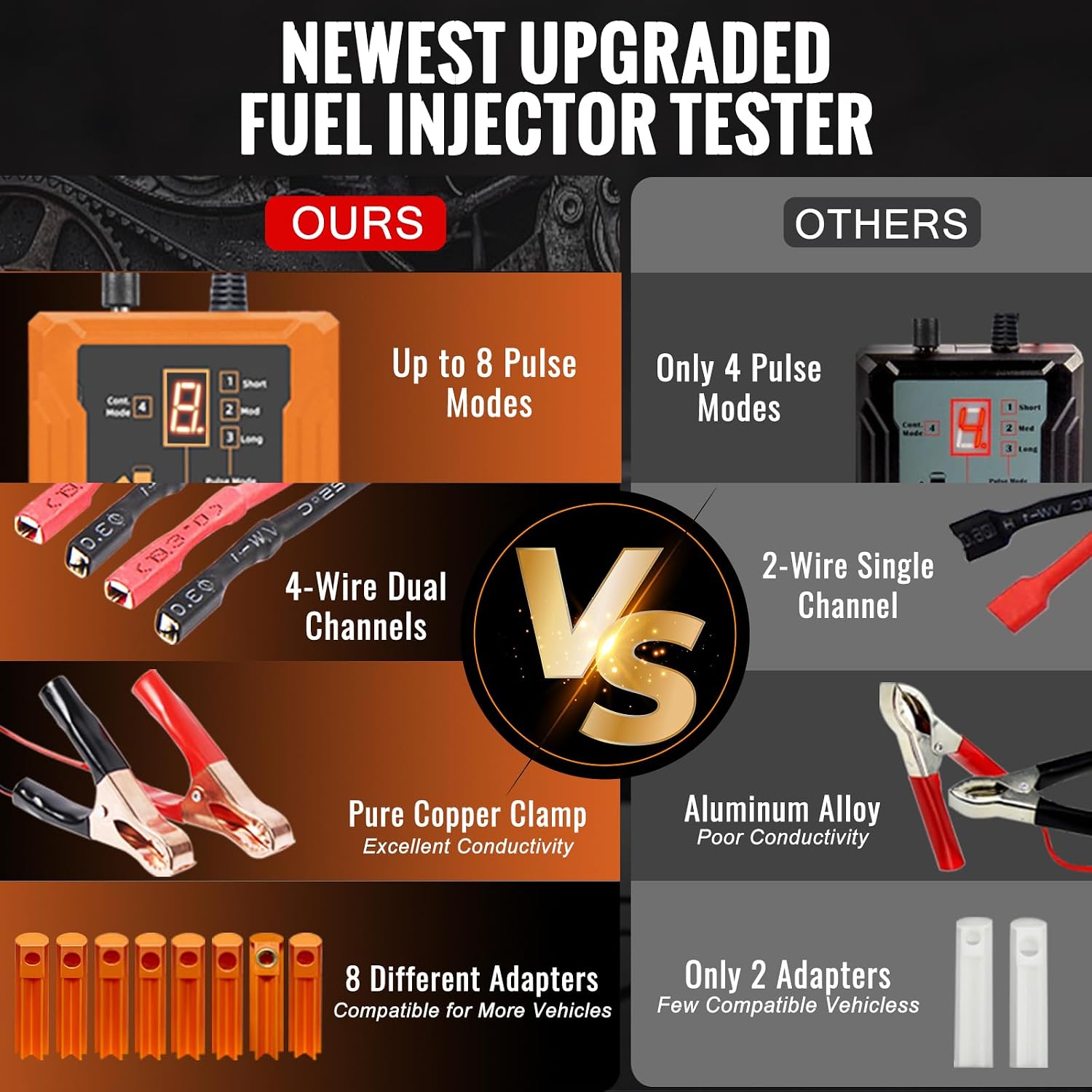
Universal
$26.89
In stock on Amazon
Check price on AmazonTier 2 — The $60–$100 Variable-Frequency Kits (FOXWELL JT200 and Comparable Rigs)
Step up to this bracket and you get adjustable pulse frequency — typically 1–25 Hz — a display that counts pulses, and in some configurations dual-channel outputs. This matters because cleaning effectiveness is partly a function of how rapidly you can cycle the solenoid. Higher frequency loosens deposits differently than slow single-pulses. Popular Mechanics’ “How Fuel Injectors Work” (popularmechanics.com) notes that solenoid-operated injectors are designed around specific opening cycles, and running them at appropriate test frequencies produces more realistic diagnostic data than single-pulse triggering.
The dual-channel confusion, clarified. Reviewers who describe dual-channel kits as difficult to operate simultaneously are almost always bench-testing removed injectors and expecting to spray-test both into cups at the same moment — which does work, but requires two cups positioned correctly. Dual-channel means the kit can independently pulse two injectors from one power source, which is genuinely useful when you are bench-testing a matched pair or comparing a known-good injector against a suspect. It does not mean the kit can test injectors while they remain installed in the engine in pairs.
The reliability flag you should not skip. Owners reviewing the FOXWELL JT200 report a specific failure mode: one lead going to full continuous power mid-session rather than pulsing. A stuck-on injector solenoid with solvent flowing through it is a spill risk, and it means you have lost control of the cleaning cycle. This failure appears in enough reviews to represent a real quality-control pattern rather than a one-off incident. If you are working near an ignition source or in a tight engine bay, that track record matters before you buy.
EM276SET
$28.49
In stock on Amazon
Check price on AmazonTier 3 — The $100–$130 Non-Dismantle Kits (AUTOOL and Similar)
This category generates the most interesting debate in the home-mechanic community. Non-dismantle injector cleaners connect to the fuel rail — typically by temporarily disabling the vehicle’s fuel pump and feeding pressurized solvent directly into the fuel system, where it cycles through the running engine. The injectors never leave the car.
The shop-backed success-rate figure worth understanding. Underhood Service’s “GDI Carbon Buildup and Injector Diagnostics” (underhoodservice.com) describes chemical flush methodology for mild-to-moderate deposit loading and notes that on-car solvent flushing addresses gum-type deposits effectively in a significant share of cases. The approach is explicitly not a cure for mechanical wear, cracked pintle seats, or carbon buildup baked onto GDI injectors over 60,000 or more miles. For light-to-moderate varnish on a port-injection engine, non-dismantle flushing is a legitimate first step before committing to removal and bench cleaning.
The honest math on single-car ownership. If you own one vehicle and run this service once every 30,000–40,000 miles, the non-dismantle kit costs $100–$130 versus a shop fuel injection service at $100–$200 per visit depending on your market. Break-even is essentially one use. The tool pays for itself if it works and if you keep the car long enough for a second service interval. If you are buying the kit to service multiple vehicles or flip cars, the math improves quickly — but at that scale you should be evaluating professional ultrasonic cleaning equipment rather than this tier.

AUTOOL
$79.99
In stock on Amazon
Check price on AmazonBy the Numbers — What You Are Actually Comparing Across Tiers
| Kit tier | Approx. price | Pulse frequency control | Flow quantification | On-car capable |
|---|---|---|---|---|
| EM276-style pulse tool | $22–$45 | Fixed (manual trigger) | No | No |
| Variable-frequency bench kit (JT200-style) | $60–$100 | Adjustable, 1–25 Hz | No | No |
| AUTOOL non-dismantle system | $100–$130 | Adjustable | No | Yes |
Universal
$26.89
In stock on Amazon
Check price on AmazonEM276SET
$28.49
In stock on Amazon
Check price on AmazonAUTOOL
$79.99
In stock on Amazon
Check price on AmazonCan a Home Tester Actually Tell You Weak Versus Dirty?
This is the question that separates a realistic buyer from a disappointed one. A home pulse tester can tell you whether an injector is electrically open or closed and give you a rough go/no-go spray pattern assessment. It cannot deliver a calibrated flow rate.
Weak injectors — ones that open fully but flow 10–15% below spec — require a flow bench with a graduated measurement system to catch reliably. Motor Magazine’s “Fuel System Diagnostics: From Code to Cure” (motor.com) makes this distinction clearly: electrical continuity tests and visual spray checks are triage tools, not final judgments. If your scanner shows a persistent lean condition on one cylinder after a pulse-clean and the injector clicks cleanly, the next diagnostic step is a shop with flow-bench capability, not another cleaning cycle.
That said, a visual spray pattern check on a bench-tested injector tells you more than most home mechanics realize. A healthy injector produces a symmetrical cone or mist. A partially clogged one produces a stream, a split pattern, or an asymmetric plume. Popular Mechanics’ “How Fuel Injectors Work” (popularmechanics.com) notes that pattern degradation is often visible well before a misfire code appears. You do not need quantitative flow data to spot that failure mode — your eyes are enough.
For GDI engines specifically, Underhood Service’s “GDI Carbon Buildup and Injector Diagnostics” (underhoodservice.com) cautions that carbon deposits form on the back of the intake valve rather than in the injector tip itself on direct-injection platforms. A clean-spraying injector on a GDI engine can still produce a cylinder that behaves like it has a dirty injector, because the carbon is upstream of where your cleaner is working. Knowing your fuel system architecture before you buy a kit saves frustration and money.
How Many Pulse Cycles Does It Take to Clean a Varnished Injector?
There is no universal number, but field practice gives us a useful range. The standard approach described across shop cleaning guides runs roughly 200–500 pulse cycles with solvent flowing, followed by a visual spray pattern check, followed by additional cycles if the pattern remains asymmetric. The solenoid hammering dislodges varnish mechanically while the solvent dissolves and carries it away. SAE International Technical Paper 2019-01-0249 (sae.org) on fuel injector flow variation reinforces why getting flow distribution right across all cylinders matters — even a moderately restricted injector that passes a basic click test can skew mixture balance enough to affect combustion efficiency and emissions.
Severely varnished injectors may not respond to bench pulsing at all. At that stage, professional ultrasonic cleaning is the step that actually works. Ultrasonic cleaning uses high-frequency sound waves transmitted through a liquid bath to agitate and remove deposits from surfaces that solvent and mechanical pulsing cannot reach. If you have run 500 cycles and the spray pattern is still a stream rather than a cone, stop cycling and source ultrasonic service instead.
Frequently Asked Questions
Do I have to remove the injectors to use a pulse-mode tester, or can I test them on the car?
Standard pulse-mode testers — EM276-style and variable-frequency bench kits — require the injector to be removed from the engine. You connect the injector’s electrical plug to the tester, hold the injector body over a collection cup, and watch for spray. AUTOOL-style non-dismantle kits are the exception: they feed solvent through the fuel rail on a running or cranking engine without removal.
Which carb cleaner can actually fits the standard adapter on EM276-style kits?
Berryman B-12 Chemtool is the can style most often named by users as engaging correctly with the standard EM276 adapter geometry. Buy it before your service session. Other brands’ aerosol valve heads vary in geometry and may not thread or press-fit into the adapter correctly.
Can a home injector tester tell me if my injector is weak versus just dirty?
Not with precision. A home tester confirms electrical operation and lets you visually assess spray pattern — both useful for catching dead or severely restricted injectors. Quantifying a 10–15% flow deficit requires a calibrated flow bench. If you have pulse-cleaned an injector, confirmed it opens cleanly, and still have a persistent lean misfire code on that cylinder, the next step is professional flow testing.
Is the non-dismantle kit worth it if I only have one car to maintain?
Probably yes, on one-service math alone — the kit price approaches what a shop charges for a single fuel injection service. The on-car flush approach works best on gum-type deposits in port-injection engines. If you are running a high-mileage GDI engine with known carbon issues, you need a more aggressive solution such as walnut blasting the intake valves.
What is the difference between a single-channel and a dual-channel kit?
A single-channel kit pulses one injector at a time. A dual-channel kit can power two injectors independently from one unit, which is useful for side-by-side comparison of a known-good injector against a suspect, or for bench-testing a matched pair before reinstalling them. It does not mean you can clean two injectors simultaneously while they remain in the engine.