June 13, 2026 • Dale Merrick • 11 min reading time • Prices verified June 5, 2026
Diesel Fuel Additives for Daily Drivers: Hot Shot's Secret, Archoil, Stanadyne, and Opti-Lube Compared
If you’ve ever stood at a diesel pump wondering whether those bottles of fuel additive next to the register are genuinely useful or just expensive marketing, you’re not alone. A diesel fuel additive is a liquid chemistry package — typically poured into your tank before or during a fill-up — designed to do one or more jobs that pump diesel fuel doesn’t fully do on its own: lubricate the precision fuel-system components that meter fuel, raise the cetane number (a measure of how readily diesel ignites, analogous to octane in gasoline but working in the opposite direction), clean injectors, or help the diesel particulate filter (DPF) — the emissions device that traps soot — do its job more efficiently. This article puts four of the most-discussed diesel additives in the daily-driver market — Hot Shot’s Secret Everyday Diesel Treatment, Archoil AR6500, Stanadyne Performance Formula, and Opti-Lube XPD — through a side-by-side comparison built around what actual owners report, what the published spec sheets say, and what the cost math looks like across a full year of driving.
| EDITOR'S PICKStanadyne Performance Formula D… | Mid-tierArchoil AR6400-D Diesel Fuel Sy… | Budget pickHot Shot’s Secret Everyday Dies… | |
|---|---|---|---|
| Volume (oz) | 16 | 12 | 16 |
| Case Count | 12 | 1 | 1 |
| Treats (gal) | — | — | 400 |
| Fuel Type | — | Diesel | Diesel |
| Price | $119.00 | $24.95 | $17.96 |
| See on Amazon → | See on Amazon → | See on Amazon → |
Why Lubricity Is the Dominant Anxiety in This Market
Before scoring individual products, it’s worth naming the fear that drives most diesel additive purchases: pump failure. Not injector clogging, not sluggish throttle response — the CP4 high-pressure fuel pump catastrophically failing and sending metal debris through the entire fuel system.
The CP4.2 pump — used in the Duramax LML (2011–2016) and the 6.7 Power Stroke before the 2020 model-year redesign — operates at injection pressures above 29,000 psi and relies on the fuel itself for lubrication. US ultra-low-sulfur diesel (ULSD), mandated by the U.S. Environmental Protection Agency under its Diesel Fuel Standards program, stripped out much of the natural lubricity that pre-ULSD fuel provided. The EPA’s diesel fuel quality framework acknowledges that ULSD lubricity can vary at the pump, and SAE International Technical Paper 2012-01-1694 documents a direct relationship between low-lubricity fuel and accelerated injection pump wear. The result: a repair bill that owners across the diesel enthusiast community describe consistently — and widely — in the $8,000–$12,000 range when the CP4 lets go and contaminates downstream components.
That’s the backdrop. Every product below is evaluated first against that standard, then on secondary merits.
The Four Contenders: What Each One Actually Does
Hot Shot’s Secret Everyday Diesel Treatment (EDT)
Archoil
$24.95
In stock on Amazon
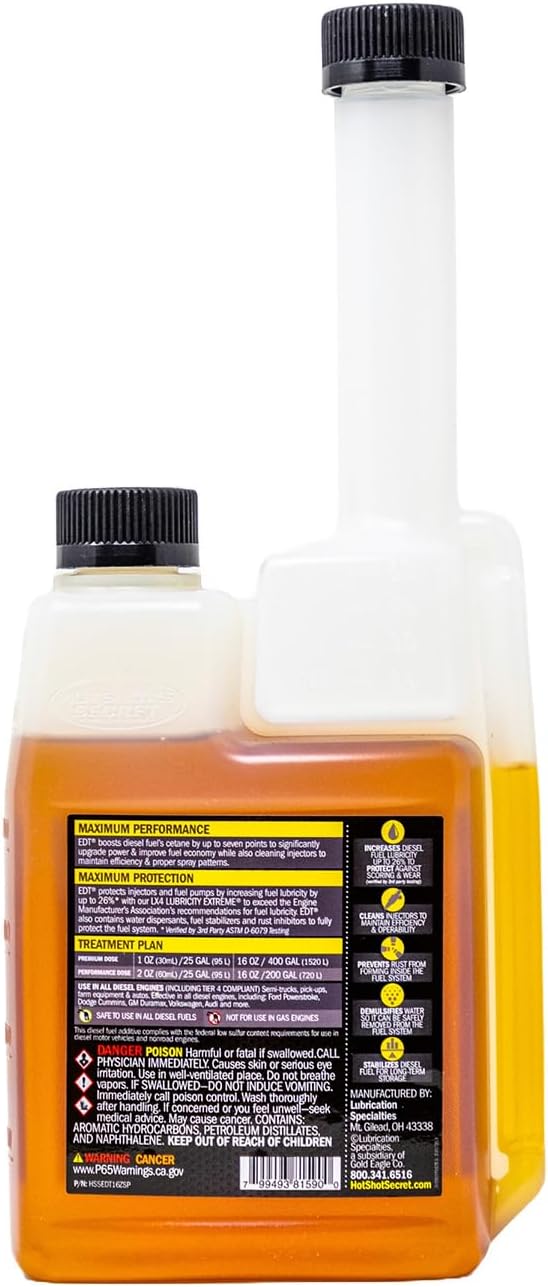
Check price on AmazonEDT is a multi-functional formula: it addresses lubricity, cetane improvement, water dispersal, and a light detergent package in a single bottle. The “everyday” positioning is literal — it’s designed for every fill-up, not periodic treatment, and the dosing math works out accordingly (one ounce per five gallons is the published treat rate).
What makes EDT distinctive in aggregated owner reviews is the brand loyalty it generates. Long-term users across diesel owner communities frequently describe adopting the full Hot Shot’s Secret ecosystem — pairing EDT with Diesel Extreme (their periodic deep-clean formula) on a mileage schedule. That pattern of repeat buyers is unusual; most additive users cycle through brands. The loyalty signal suggests owners are seeing consistent enough results — smoother cold starts, quieter injector clatter on older engines, stable fuel economy — to stay committed.
EDT’s published cetane improvement claim is up to seven numbers on a cetane index scale. That’s a meaningful but not extraordinary claim; the industry range for consumer additives runs roughly four to eight numbers.
Trade-off to name explicitly: EDT’s detergent chemistry is moderate — adequate for maintenance but not a DPF-regeneration tool or an aggressive injector deposit cleaner. If your vehicle has accumulated carbon deposits or you’re dealing with a DPF regen frequency problem, EDT alone probably isn’t the lever to pull.
Archoil
$24.95
In stock on Amazon
Check price on AmazonArchoil AR6500
Stanadyne
$119.00
In stock on Amazon
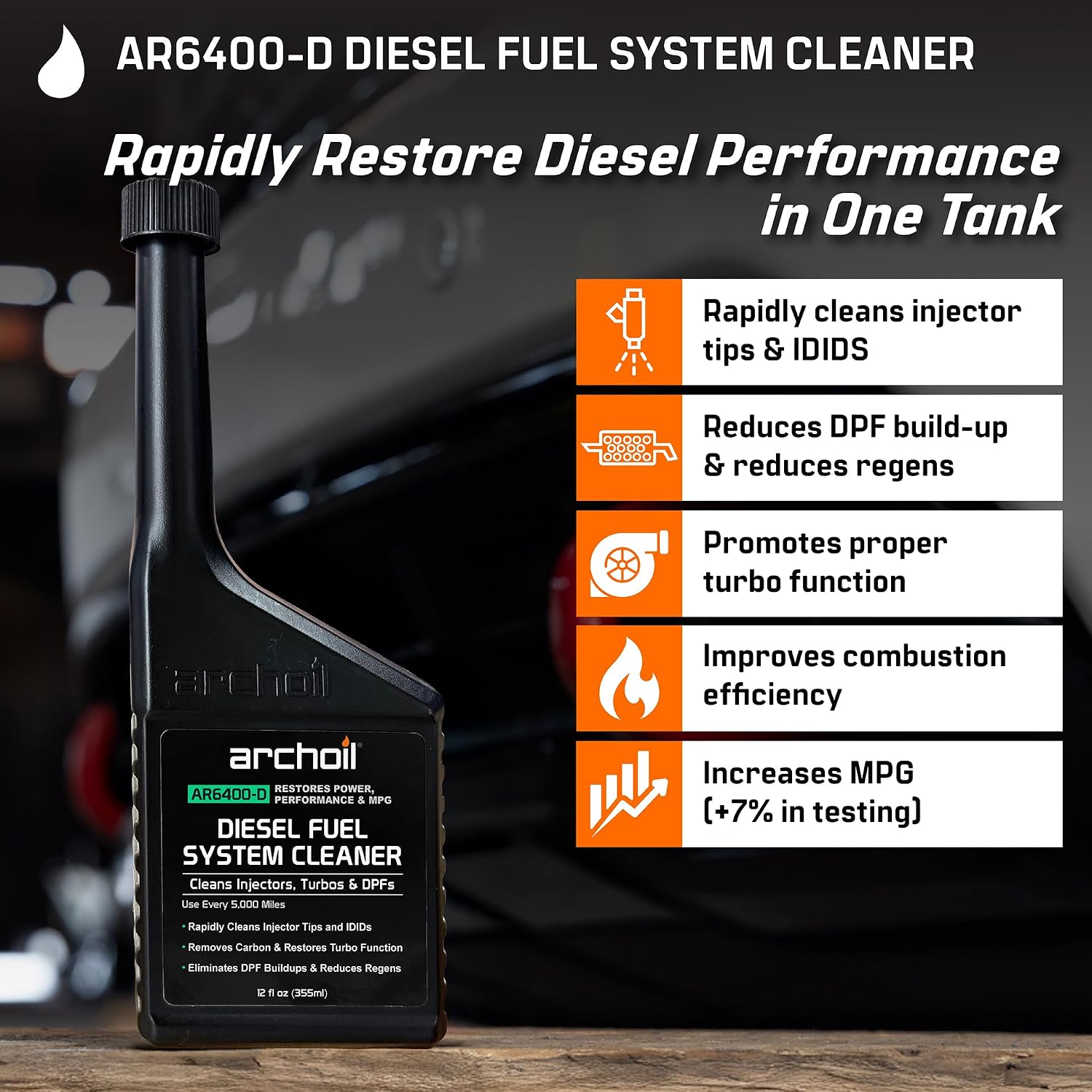
Check price on AmazonArchoil built its diesel additive reputation on one specific claim: a nanotechnology-based friction modifier — an organosilicate compound — that the brand says forms a protective boundary layer on metal surfaces, including high-pressure pump components. Archoil AR6500 is their fuel-system-specific formulation.
The most dramatic individual owner account in the diesel additive review corpus involves AR6500: one owner of a BMW X5 35d — which uses the Bosch CP4.1 pump — reports that consistent AR6500 use, combined with catching an early DPF issue, allowed them to avoid a costly repair quoted by a dealer at more than $2,000. This is one owner’s documented experience and is presented here with appropriate uncertainty; it is a single data point, not a clinical trial. What it does illustrate is that AR6500 attracts buyers who are treating fuel system protection as insurance — not performance chasing — and who appear to see it as genuinely preventing the failure mode they fear.
AR6500’s lubricity additive package consistently appears in discussions of CP4-equipped vehicles, where owners cite it as one of a small number of products they trust with a pump they know is vulnerable.
Trade-off: Archoil AR6500 is priced at the upper end of the consumer diesel additive segment. The friction-modifier chemistry is real, but there is no publicly available third-party HFRR (High-Frequency Reciprocating Rig — the standard lubricity bench test) data published by the brand to quantify wear-reduction claims at a precise level. You are, to some extent, buying into the owner-community consensus.
Stanadyne
$119.00
In stock on Amazon
Check price on AmazonStanadyne Performance Formula
Archoil
$24.95
In stock on Amazon
Check price on AmazonStanadyne is a different kind of product in this comparison, and the tone of its buyers reflects that. Stanadyne LLC — the manufacturer — is itself a diesel fuel-injection system OEM; they make injection pumps. The Performance Formula additive is developed by the same engineering organization that builds hardware. That OEM-adjacent credibility is the entire brand identity, and buyers respond to it with a tone that’s notably more skeptical-and-satisfied than the Hot Shot’s Secret or Archoil audiences — methodical owners who have done their research, don’t want to be sold, and consistently report staying with Stanadyne because it never gives them a reason to switch.
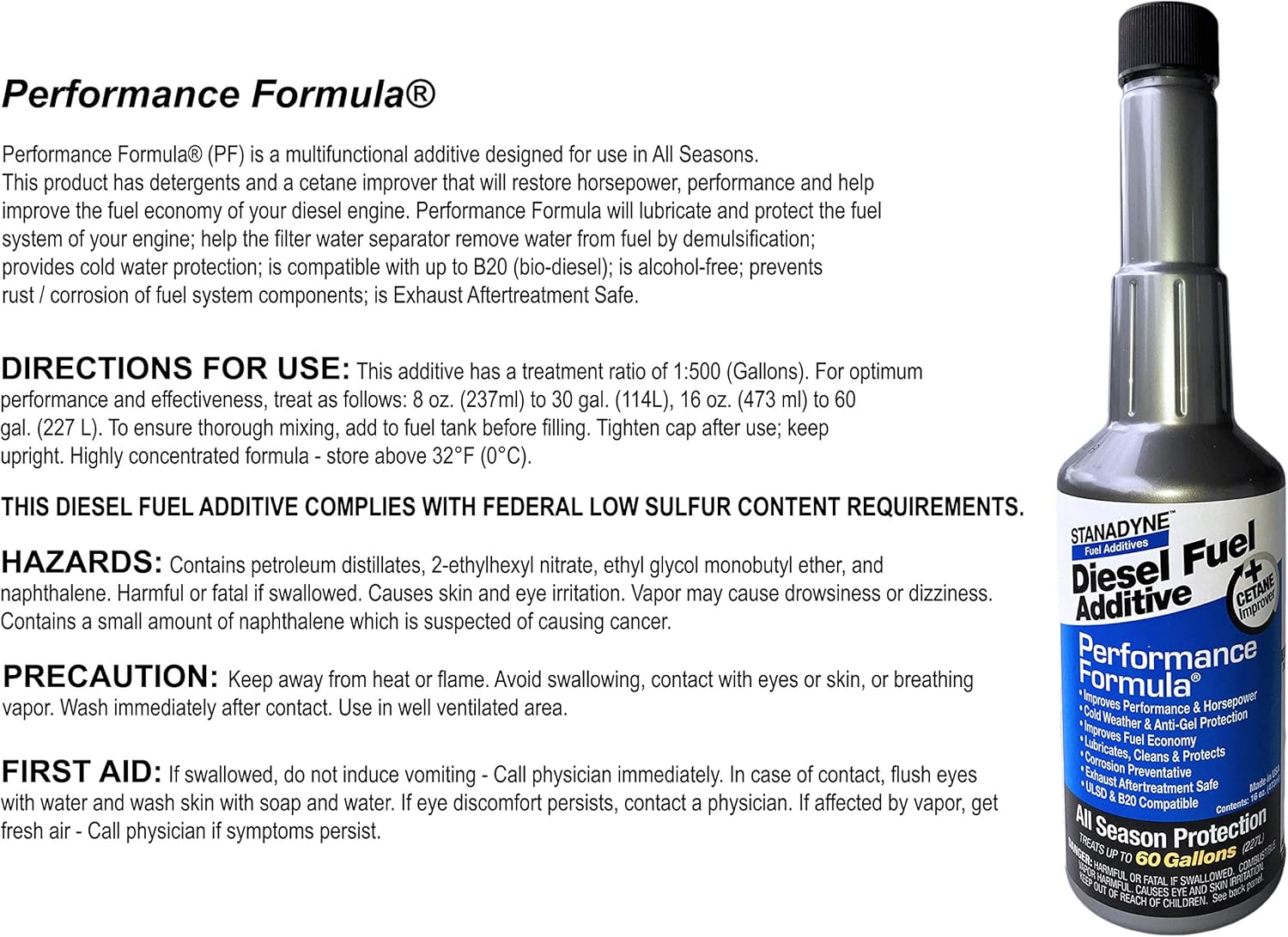
Per Stanadyne LLC’s published product data sheet and OEM approval documentation, the Performance Formula carries documented compatibility approvals from several diesel engine manufacturers. The brand is particularly well-represented among Cummins-powered vehicles — Ram 2500/3500 and medium-duty applications — though buyers should verify current approval documentation directly with Stanadyne, as OEM approval letters are version- and product-specific.
The formula addresses lubricity, cetane (the published claim is up to five numbers), water demulsification, and injector cleanliness. It does not position itself as a friction-modifier “treatment” in the AR6500 sense — the approach is more conservative, additive-package chemistry that works with ULSD rather than compensating for it with novel friction chemistry.
Trade-off: Stanadyne Performance Formula is the most conservative option in this comparison. If you want measurable, documented OEM credibility and a no-drama long-term maintenance additive, it earns that role. If you’re looking for maximum cetane boost or aggressive injector detergency, other products in this comparison outperform it on those specific axes.
Archoil
$24.95
In stock on Amazon
Check price on AmazonOpti-Lube XPD
Hot
$17.96
In stock on Amazon
Check price on AmazonOpti-Lube XPD (the “XPD” designation standing for Extreme Performance Diesel) is the most lubricity-focused formula of the four, per the brand’s published specification sheet from Opti-Lube Inc. The XPD is designed specifically for maximum lubricity improvement, and operators who prioritize HFRR test performance above other parameters consistently cite it.
Per Opti-Lube Inc.’s published product specification data, the XPD formulation passes industry HFRR lubricity thresholds at treat rates that make it genuinely cost-competitive per gallon of protection. The formula also includes a cetane improver and fuel stabilizer but does not lead with those features — lubricity is the product’s declared first priority.
Owners on CP4-equipped vehicles appear frequently in Opti-Lube discussions, often alongside statements about not being willing to gamble on cheaper alternatives. That’s a meaningful pattern. For high-stakes pump-protection scenarios, Opti-Lube XPD is the option where the spec sheet and the owner sentiment most directly align with the failure mode being addressed. For budget-conscious buyers who want a product focused almost entirely on the one metric that matters most for CP4 survival, XPD also delivers strong value per treated gallon compared to broader multi-function formulas.
Trade-off: XPD is a lighter formula on the detergent and cleaning side than EDT or Archoil AR6500. It’s engineered for protection, not restoration. If your injectors have significant deposits, XPD keeps the fuel system lubricated but won’t clean what’s already built up.
Hot
$17.96
In stock on Amazon
Check price on AmazonBy the Numbers: Quick Comparison
| Product | Cetane Boost (published) | Primary Strength | Best Fit | Tier |
|---|---|---|---|---|
| Hot Shot’s Secret EDT | Up to +7 | All-in-one maintenance | Every-fill-up daily driver | Archoil — $24.95 |
| Archoil AR6500 | Not primary claim | Friction-modifier lubricity | CP4 protection, BMW diesel | Stanadyne — $119.00 |
| Stanadyne Performance Formula | Up to +5 | OEM-credentialed consistency | Cummins operators, skeptical buyers | Archoil — $24.95 |
| Opti-Lube XPD | Included, not primary | Maximum HFRR lubricity | CP4-equipped trucks, value-focused buyers | Hot — $17.96 |
Decision Framework: If X, Then Y
The decision here is genuinely platform-dependent, and pretending otherwise wastes your time.
If you own a CP4-equipped truck (Duramax LML 2011–2016, 6.7 Power Stroke pre-2020) and lubricity is your primary anxiety: Opti-Lube XPD or Archoil AR6500 are the two options where owner consensus and published-spec emphasis most directly address that specific failure mode. XPD if you want documented HFRR performance; AR6500 if you want friction-modifier chemistry and are comfortable with owner-community validation over published test data.
If you want OEM-adjacent documentation and plan to run a Cummins-powered vehicle long-term: Stanadyne Performance Formula is the appropriate choice. The buyer profile it attracts — methodical, skeptical, long-term — matches what it delivers.
If you want a single all-in-one formula you can buy in bulk and use every fill-up without thinking hard about it: Hot Shot’s Secret EDT’s treat rate, ecosystem depth, and brand loyalty pattern make it the practical everyday choice for most daily drivers that aren’t running a high-risk pump configuration.
If your truck has an existing DPF problem or injector deposits: None of these four additives replaces a shop-level DPF service or ultrasonic injector cleaning. Address the mechanical issue first; then maintain with an additive.
Frequently Asked Questions
Is US diesel fuel really low enough in lubricity to require an additive on every fill-up?
For most vehicles, it depends on the pump type. The U.S. EPA’s Diesel Fuel Standards program sets a minimum lubricity threshold for ULSD, but fuel at the pump can vary — and for CP4-equipped vehicles, that variation matters more than it does for older rotary or inline pumps that tolerate lubricity variation better. For a standard Cummins or newer 6.7 Power Stroke (post-2020 redesign), an additive is a reasonable precaution rather than a strict necessity. For CP4-equipped trucks, the engineering and owner-community consensus both lean toward treating every fill-up as the defensible choice.
Can a diesel fuel additive actually extend DPF regen intervals, or is that just placebo?
Fuel additives with effective detergent chemistry can reduce the rate at which injectors deposit combustion byproducts that eventually reach the DPF, which in theory supports longer regen intervals. However, DPF regen frequency is driven by many variables — driving cycles, oil consumption, EGR function, injector wear — and attributing a change in regen interval to an additive in isolation is genuinely difficult. The Archoil AR6500 BMW owner experience cited above is the most specific owner-reported DPF-related claim in this product set; it is plausible but not independently verified. Treat additive-driven DPF improvement as a possible secondary benefit, not a guaranteed outcome.
What is the difference between a cetane booster and a lubricity additive — do you need both?
Cetane improvers — typically compounds such as 2-ethylhexyl nitrate or di-tert-butyl peroxide — reduce ignition delay, the time between injection and combustion, which can improve cold starts and reduce combustion noise. Lubricity additives, typically fatty acid esters or similar boundary-layer chemistry, protect metal surfaces from wear. They are chemically distinct functions. Most multi-function diesel additives in this comparison address both, but with different emphasis. In a modern common-rail diesel running marginal-lubricity ULSD, lubricity protection is the higher-stakes need; cetane improvement is a secondary benefit worth having but rarely the deciding factor.
Which additive is safest for a CP4 high-pressure fuel pump?
Based on published specification emphasis and owner-community consensus across diesel-specific long-run review aggregations, Opti-Lube XPD and Archoil AR6500 are the two products most consistently cited by CP4-owning operators. Both address the lubricity gap that makes the CP4 vulnerable; the choice between them comes down to whether you prioritize documented HFRR test performance (XPD) or friction-modifier chemistry with strong owner validation (AR6500).
Does Stanadyne have any documented OEM approval from Cummins or other manufacturers?
Per Stanadyne LLC’s published product approval documentation, Stanadyne Performance Formula has OEM approval relationships with diesel engine manufacturers. Buyers seeking to verify current, version-specific approvals — particularly for warranty compliance — should request the current OEM approval letter directly from Stanadyne, as approval documentation is product-version and market-specific. Relying on a general claim without the current letter is not advisable for fleet or warranty-sensitive applications.