June 27, 2026 • Dale Merrick • 9 min reading time • Prices verified June 5, 2026
Diesel Fuel Additives Ranked: Cetane, Lubricity, DPF Safety, and Cost Per Tank
If you’ve ever stood in the auto parts store aisle staring at a shelf full of diesel additive bottles — each one promising more power, better economy, and a cleaner engine — and had absolutely no idea which claim to trust, this guide is for you. Diesel fuel additives are liquid treatments you add directly to your fuel tank to improve something specific about how that fuel performs: its ignition quality (called cetane number), its ability to protect metal fuel system parts from wear (called lubricity), or its compatibility with the exhaust filter that modern diesel trucks and passenger cars use to control soot emissions (called the DPF, or diesel particulate filter). Buy the wrong product and you can either waste money on chemistry that doesn’t match your engine’s real needs, or — in the DPF case — actually damage a component that costs $1,500 to $3,000 to replace. Buy the right one on a consistent schedule and independent shop operators consistently report measurable reductions in injector wear callbacks and cold-start complaints. This guide ranks the major product categories across those four decision axes — cetane, lubricity, DPF safety, and cost per tank — so you can match a product to an actual use case.
The Four Axes That Actually Matter
Before getting into specific products, it’s worth establishing why these four metrics and not the dozen other claims on the bottle.
Cetane number is the diesel equivalent of gasoline’s octane rating, except it works in reverse: higher cetane means the fuel ignites more readily when compressed, not less. The EPA’s diesel fuel standards document notes that U.S. pump diesel is required to meet a minimum cetane index of 40, but real-world pump fuel frequently tests between 42 and 45 — well below the 50–55 range that common rail injection systems in late-model turbodiesels are calibrated to prefer, per Delphi Technologies’ common rail service bulletin. A cetane improver closes that gap. The SAE technical paper on cetane and combustion (SAE 2018-01-1724) documents measurable reductions in combustion noise, cold-start white smoke, and NOx precursor formation at cetane levels above 50 compared to baseline 42-cetane fuel.
Lubricity matters because Ultra-Low Sulfur Diesel (ULSD), mandated nationwide since 2006, stripped out the sulfur compounds that coincidentally lubricated fuel injection components in older diesel fuel. The injector pump and the injectors themselves depend on the fuel as their only lubricant — there’s no oil film. Lubrication Engineers’ white paper on diesel lubricity cites the HFRR (High-Frequency Reciprocating Rig) test, the industry standard for measuring fuel film wear: the threshold is 460 microns of wear scar diameter; good fuel sits below 400; some winter-blend pump diesel has tested above 500 in cold-weather conditions. An additive with a verified lubricity improver — typically a fatty acid methyl ester (FAME) derivative or a dedicated boundary lubricant chemistry — can pull that number back into the safe zone.
DPF safety is the non-negotiable filter on any modern diesel application built after approximately 2007. A DPF traps soot particles from exhaust gases, then periodically burns them off in a process called regeneration. Certain additive chemistries — particularly high-ash formulations using metallic combustion catalysts — leave behind non-combustible residue that accumulates in the DPF substrate and shortens its service life. Car and Driver’s overview of diesel additives explicitly flags this risk: any additive used in a DPF-equipped vehicle should carry a verified “DPF-safe” claim from the manufacturer, ideally backed by a low-SAPS (Sulfated Ash, Phosphorus, Sulfur) chemistry statement. If a product doesn’t address this directly on its label or SDS sheet, that’s a disqualifying red flag for late-model trucks, Sprinters, and European platform diesels.
Cost per tank is where the math either validates or kills the purchase. A cetane booster that costs $18 per treatment on a 35-gallon fuel tank — a common Class 2–3 pickup tank size — is $0.51 per gallon of additive cost. If that same truck gets roughly 500 miles per tank, the additive is costing 3.6 cents per mile before any fuel-economy benefit. Whether that math works depends entirely on what the product actually delivers.
Product Categories Ranked by Use Case
Category 1 — All-in-One Diesel Treatments (Best for Most Buyers)
Products like Power Service Diesel Kleen + Cetane Boost, Stanadyne Performance Formula, and Lucas Fuel Treatment (diesel-rated version) lead this segment in aggregated owner reviews across independent diesel forums and shop feedback. Popular Mechanics’ roundup of diesel fuel additives consistently places Power Service’s Diesel Kleen near the top for combining a verified cetane improver, a lubricity additive, and a detergent package in a single pour. Published specs put cetane improvement at 3–6 numbers at the recommended treat rate, with HFRR wear scar reduction to sub-420 microns documented in manufacturer testing data.
The trade-off: all-in-one products are optimized for average conditions. If your primary need is aggressive carbon deposit removal (think a 150,000-mile injector with stiction issues), a dedicated detergent-concentrate treatment will outperform any all-in-one in that single category. But for maintenance dosing on a well-maintained engine — the interval treatment that prevents the problem rather than fixes it — the all-in-ones win on simplicity and cost.
DPF safety: Power Service Diesel Kleen and Stanadyne Performance Formula both carry explicit DPF-safe claims. Lucas Fuel Treatment does as well, though some fleet operators report confirming this against the current SDS before deployment on newer platforms is best practice, since formulations are periodically revised.
Category 2 — Concentrated Cetane-Only Boosters (Best for Cold Climate and High-Altitude Ops)
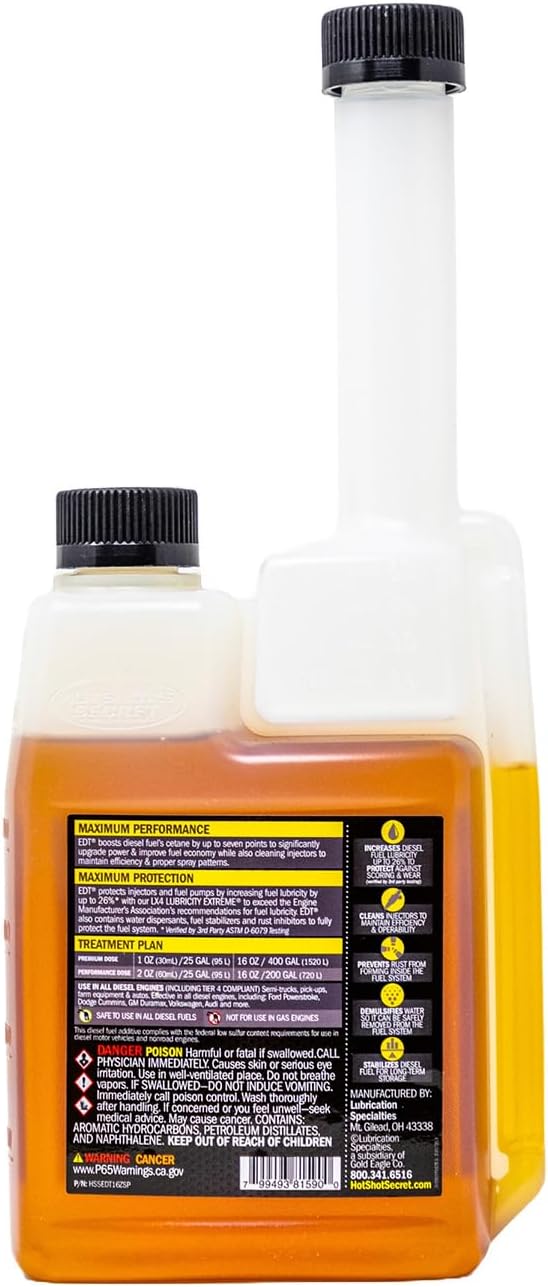
Archoil AR6200, Hot Shot’s Secret Diesel Extreme, and Diesel Power Plus occupy this segment. Their value proposition is targeted: maximum cetane improvement per dose, often rated at 6–8 cetane numbers at full treat rate, alongside an injector detergent and, in the case of Hot Shot’s Secret, a stiction eliminator chemistry aimed at HEUI injectors (the hydraulic electronic unit injectors used in older Ford 6.0 and 7.3 Power Stroke platforms). Owner reports across long-term diesel communities consistently flag AR6200 as particularly effective at cleaning common rail injector tips over a 3–5 tank treatment cycle.
Cost math on this tier is less favorable for casual use. Hot Shot’s Secret Diesel Extreme runs approximately $30–$38 for a treatment sized to 30–100 gallons depending on condition of the fuel system. Per Popular Mechanics’ analysis, this positions it as a periodic correction treatment (every 6,000–10,000 miles) rather than a fill-up-by-fill-up maintenance product.
DPF safety: both AR6200 and Hot Shot’s Secret Diesel Extreme explicitly document DPF-safe chemistry. Verify the current SDS for any product before deploying on Euro 6 emission platforms, where particulate filter substrate tolerances are tighter than U.S. DPF specifications.
Category 3 — Professional and Fleet-Grade Treatments
BG Products’ Diesel Induction Service kit, Liqui-Moly Diesel Purge, and the CRC DI-6 Diesel Fuel System Cleaner are the relevant names in this segment. These are sold through professional channels or in higher-concentration formats designed for either shop service (BG) or direct-to-consumer enthusiast purchase (Liqui-Moly, CRC).
Liqui-Moly Diesel Purge is worth calling out specifically for the European-platform diesel owner — Audi, BMW, Mercedes-Benz TDI and CDI owners specifically. Liqui-Moly holds documented OEM approvals from several European manufacturers and is formulated explicitly to SAPS-limited specifications compatible with Euro 5 and Euro 6 DPF systems. Operators maintaining late-model German platform diesels consistently cite Liqui-Moly Jectron and Diesel Purge as the chemistry they default to precisely because the OEM approval trail removes the guesswork. Pricing runs higher — Diesel Purge is approximately $22–$28 for a 500ml treatment — but the per-treatment cost is defensible against the alternative of a DPF replacement or injector service.
By the Numbers
| Product Category | Typical Cost / Treatment | Cetane Gain (mfr. rated) | DPF-Safe Claim | Best Interval |
|---|---|---|---|---|
| All-in-One (Power Service, Lucas) | $8–$18 | +3 to +5 | Yes | Every fill-up |
| Concentrated Boost (AR6200, Hot Shot’s) | $28–$40 | +6 to +8 | Yes | Every 6k–10k mi |
| Professional / Euro (Liqui-Moly, BG) | $22–$65+ | Varies | Yes (verify by SKU) | Every 10k–15k mi |
Decision Framework: If X, Then Y
The goal of stacking all of this into one buying decision is simple. Here’s the honest if/then structure:
If you drive a DPF-equipped truck or SUV (2007 or newer, U.S. market) and want a simple maintenance protocol: Use Power Service Diesel Kleen + Cetane Boost or Stanadyne Performance Formula at every fill-up or every other fill-up. At $8–$15 per treatment on a typical 26-gallon tank, you’re spending under $0.60/gallon additive cost for verified cetane improvement, lubricity protection, and DPF-safe chemistry. This is the lowest-complexity, best-value maintenance answer.
If you’re running an older HEUI-injector platform (Ford 7.3/6.0 Power Stroke, early Navistar) with stiction complaints or rough idle: Hot Shot’s Secret Diesel Extreme or Archoil AR6200 is the targeted answer. Budget for a 3-tank treatment cycle before evaluating results; owners consistently report the improvement being gradual rather than immediate. Stiction eliminator chemistry works through accumulation, not a single flush.
If you’re maintaining a European-market diesel or a U.S.-spec vehicle with a Euro-origin engine (Sprinter, VW/Audi TDI, BMW xDrive diesel): Default to Liqui-Moly Diesel Purge or Liqui-Moly Super Diesel Additive and verify the OEM approval code on the label against your manufacturer’s specification list. The DPF substrate specifications on Euro 6 platforms are tight enough that chemistry verification isn’t optional — it’s the entire decision.
If you operate a diesel fleet or a shop and are evaluating professional system service: BG Products’ diesel service kit is the category leader for in-shop injector and induction cleaning with documented fleet operator approval rates. The per-unit economics require volume to justify the BG equipment investment, but operators who have crossed into regular fleet service volume consistently report the per-vehicle treatment cost drops well below retail-product maintenance costs at scale.
If cetane is your only concern (cold-climate operation, high-altitude routes, consistent hard pulls): a concentrated cetane-only booster dosed at the aggressive end of its treat rate window will outperform any all-in-one in that single metric. Stack it with a separate lubricity improver if your pump diesel source is known to be borderline on HFRR scores — a real concern in winter blends in northern states, per Lubrication Engineers’ technical documentation on ULSD winter performance.
The honest bottom line is that no single product is the universal best answer, which is exactly why the marketing claims feel interchangeable — because the products themselves overlap heavily in what they address. Match the chemistry to the engine platform, verify the DPF safety claim, run the cost-per-treatment math against your fill interval, and the decision becomes straightforward.