June 12, 2026 • Dale Merrick • 8 min reading time • Prices verified June 5, 2026
Catalytic Converter Cleaners: Separating the Chemistry That Works From the Check-Engine-Light Hype
If your check-engine light came on and the code reader said something like “P0420 — Catalyst System Efficiency Below Threshold,” you probably went straight to the internet and found two paths: a $200–$1,100 catalytic converter replacement quote, or a $12 bottle of something that promises to clean your cat and make the light go away. That gap in price is real, and so is the temptation. A catalytic converter is the device in your exhaust system that chemically converts harmful combustion byproducts — carbon monoxide, unburned hydrocarbons, and nitrogen oxides — into less harmful gases before they leave the tailpipe. When emissions regulators or your PCM (the engine’s onboard computer) decide it isn’t working efficiently enough, you get that code and that light.
This article is for the reader who already knows the code, suspects the product marketing is oversimplified, and wants the honest answer before spending money in either direction. We’ll break down what these additives can and can’t do, which product categories actually touch catalyst chemistry, and how to build a clear decision rule before your next repair order or parts run.
What a Catalytic Converter Cleaner Is Actually Claiming to Do
The phrase “catalytic converter cleaner” gets applied to at least three distinct product categories, and conflating them is where most of the frustration starts.
Category 1: Fuel system cleaners with upstream combustion benefits. Products like Chevron Techron Concentrate Plus, Liqui-Moly Jectron, and CRC GDI IVD Intake Valve & Turbo Cleaner are primarily polyetheramine (PEA)- or polyisobutylene amine (PIBA)-based detergent packages. Their legitimate mechanism is cleaning injectors and, in some formulations, intake valves — which improves combustion completeness and reduces the raw hydrocarbons entering the exhaust stream. A cleaner burn produces fewer partially combusted fuel molecules hitting the catalyst substrate. Per SAE International’s 2019 technical paper on fuel-borne additives and three-way catalyst efficiency, improved injector spray pattern and atomization measurably reduces hydrocarbon slip past the combustion event. The catalyst still has less contamination to manage over time. This is real chemistry, but it’s indirect — it supports catalyst health, it does not repair a degraded catalyst.
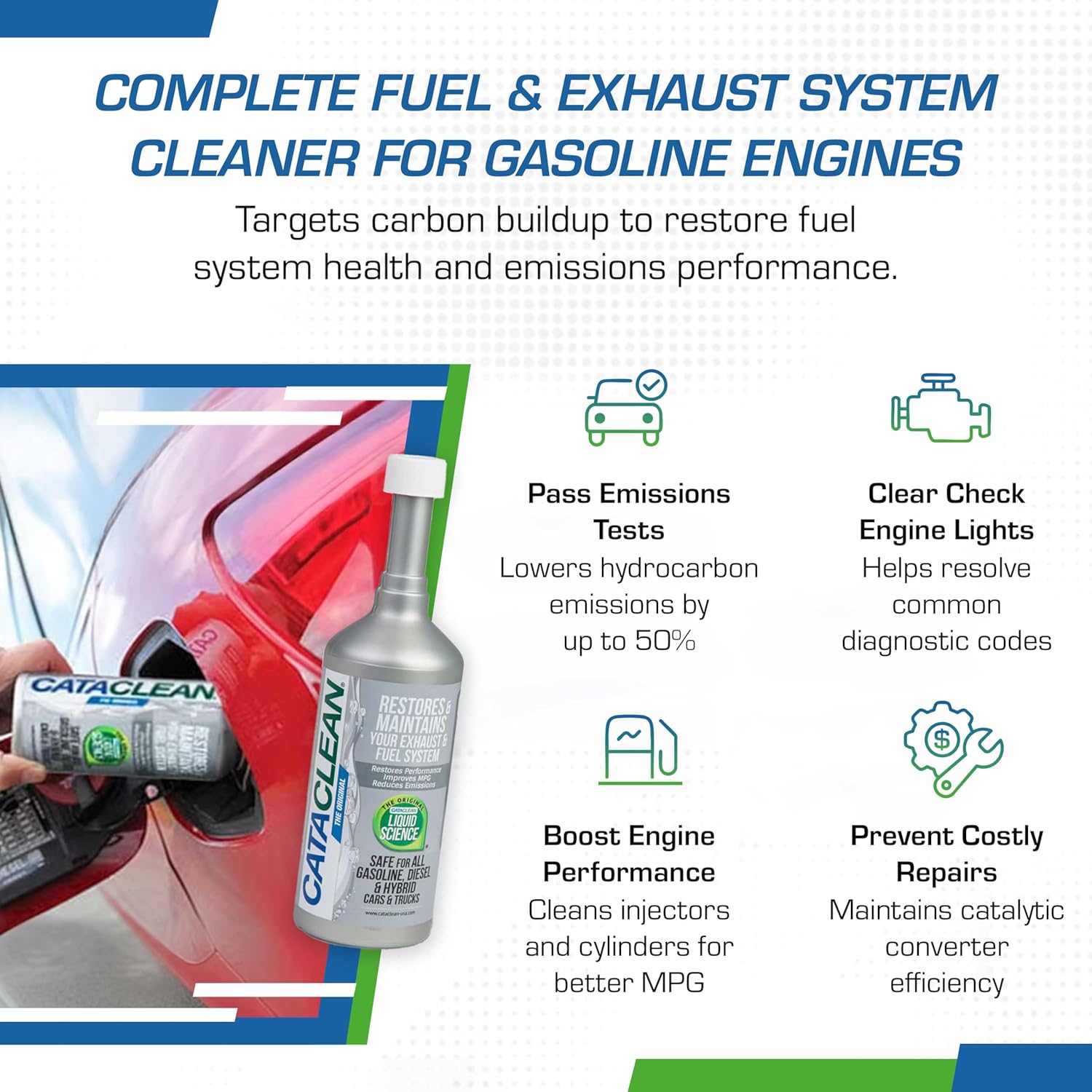
Category 2: Direct catalyst-surface treatments. Some products marketed specifically as “catalytic converter cleaners” — Cataclean being the most widely distributed example, available at most auto parts retailers for roughly $25–$35 per 450 mL treatment as of mid-2026 — claim a more direct mechanism. Their active chemistry typically includes hydrocarbon solvents (often isopropanol, acetone, or similar) that vaporize in the exhaust stream and interact with carbon, sulfur, and phosphorus deposits on the catalyst substrate and oxygen sensor surfaces. Popular Mechanics’ breakdown of how fuel-born solvents reach exhaust components notes that high-temperature vaporization is the operative mechanism — the cleaning agent has to survive combustion, enter the exhaust as a vapor, and contact the substrate at operating temperature.
Category 3: Products that are primarily just high-quality fuel. Premium gasoline from Tier 1 Top Tier certified brands already contains detergent additive packages above the EPA minimum. Running Top Tier fuel consistently is the cheapest long-term catalyst support strategy, but it won’t rescue a catalyst that is already chemically aged or physically damaged.
Understanding which category you’re buying matters more than the brand name on the label.
When the Chemistry Has a Fighting Chance — and When It Doesn’t
Here’s the honest decision frame: a P0420 code has multiple root causes, and the additive only addresses one of them.
Causes where a cleaning product has genuine potential:
-
Carbon and deposit fouling on the substrate. If the catalyst is physically intact but coated with carbonaceous deposits from extended rich-running, oil consumption, or low-quality fuel, the solvent-vaporization mechanism of products like Cataclean can restore some surface area. Underhood Service’s diagnostic guidance on P0420 explicitly notes that misfires and rich-trim operation accelerate deposit loading on catalyst substrates and that eliminating those conditions — plus a cleaning treatment — can return marginal cats to compliance.
-
Oxygen sensor contamination. The PCM determines catalyst efficiency by comparing the signal patterns of upstream and downstream O2 sensors. If a downstream sensor is sluggish from sulfur or silicone contamination rather than the catalyst itself being degraded, cleaning the exhaust stream can affect the sensor’s response characteristics. This is an edge case, but it’s a real one.
Causes where a cleaning product will not help:
-
Thermally damaged substrate. A catalyst that has been exposed to sustained misfires, running excessively rich, or overheating develops sintered or melted substrate — the precious-metal-coated honeycomb structure is physically destroyed. No liquid chemistry fixes sintered cordierite or melted palladium/rhodium washcoat. Car and Driver’s replacement cost guide notes that this is the most common failure mode in high-mileage vehicles over 120,000 miles, and it is a mechanical replacement situation.
-
Phosphorus and zinc poisoning from oil consumption. ZDDP (zinc dialkyldithiophosphate) is the anti-wear additive in motor oil. When an engine burns oil, ZDDP-derived phosphorus and zinc compounds coat the catalyst washcoat and permanently deactivate the precious metal sites. This is a chemical deactivation, not a deposit problem. Per the EPA’s emission control systems guidance, phosphorus poisoning is irreversible without physical replacement of the catalyst or professional substrate regeneration — neither of which a bottle of additive accomplishes.
-
Codes caused by other upstream faults. A leaking exhaust manifold gasket upstream of the O2 sensor, a vacuum leak causing lean conditions, or a failing mass air flow sensor can all trigger P0420 without the catalyst being at fault. Treating the cat in this scenario wastes money and delays finding the actual problem.
By the Numbers
| Scenario | Additive Likely Helps? | Estimated Cost if It Works | Estimated Cost if It Doesn’t |
|---|---|---|---|
| Light deposit fouling, recent rich-run history | Yes — moderate probability | $25–$35 (treatment) | $350–$1,100 (cat replacement) |
| O2 sensor contamination, catalyst intact | Possible — low probability | $25–$35 | $80–$200 (O2 sensor replacement) |
| Thermal damage / substrate melt | No | $25–$35 wasted | $350–$1,100 still due |
| Phosphorus poisoning from oil consumption | No | $25–$35 wasted | $350–$1,100 + oil consumption diagnosis |
The expected-value math is relatively favorable for a first attempt with a cleaning treatment only if the vehicle has a documented history that points toward deposits: recent injector fouling, inconsistent fuel quality, a recently resolved rich-running condition, or a misfire that was corrected within the last 10,000 miles. If the car is high-mileage with known oil consumption, skip the bottle and save toward the replacement.
Product-Level Decision Frame: Which Category Fits Your Situation
For the daily driver with a marginal P0420 and no other symptoms: Cataclean is the most widely cited direct-treatment product in this category. Operators in long-run forum reviews note it most reliably when used according to the label protocol — low fuel level, full treatment added, highway drive cycle at sustained RPM to generate exhaust temperature. One treatment of a warm catalyst under load is the mechanism. A single cold idle does nothing. The EPA’s guidance on catalyst light-off temperature confirms that three-way catalysts operate effectively only above approximately 400°C (750°F) — highway driving puts you there; city idling often does not.
For GDI engine owners concerned about ongoing catalyst health: Layering a high-PEA concentration injector cleaner like Chevron Techron Concentrate Plus or Liqui-Moly Jectron into your maintenance rotation — every 5,000–7,500 miles on GDI engines — reduces the hydrocarbon loading the catalyst has to manage. This is preventive, not corrective, but it’s defensible chemistry. The SAE paper on fuel-borne additive effects on catalyst efficiency documents measurable improvements in catalyst-out hydrocarbon concentrations when combustion quality improves upstream.
For independent shop owners managing P0420 tickets: The highest-value workflow is the diagnostic one: confirm no upstream faults, verify O2 sensor response characteristics with a live scan, assess oil consumption, check for physical substrate rattle. If none of those point to irreversible damage, a cleaning protocol is a legitimate step-one conversation with the customer before quoting a replacement. Underhood Service’s P0420 diagnostic workflow frames this clearly — the cleaning treatment is a low-cost diagnostic tool as much as a repair. If the code clears and stays cleared through two complete drive cycles, you have your answer. If it returns within 500 miles, proceed to mechanical replacement.
For European-car owners (BMW, Audi, VW, Mercedes-Benz): OEM approval chemistry matters here. Liqui-Moly’s Catalytic-System Cleaner carries documented compatibility notes for applications meeting OEM specifications across VAG and BMW platforms, and Liqui-Moly publishes application guides updated annually. At approximately €15–€20 per treatment (roughly $16–$22 at mid-2026 exchange rates), it occupies the right cost tier for a first-attempt cleaning protocol before escalating to dealership diagnosis.
The Decision Rule
Here’s the summary frame:
If the P0420 appeared after a resolved misfire, a period of low-quality fuel, or documented injector fouling — and the engine has under 100,000 miles with no known oil consumption — then a direct-treatment product (Cataclean, Liqui-Moly Catalytic-System Cleaner) used under the correct protocol is a reasonable $25–$35 first step. Drive it through two full OBD drive cycles before drawing conclusions.
If the engine burns oil, the substrate rattles, the code reappeared within 500 miles of a prior cleaning attempt, or the vehicle has over 120,000 miles with no mileage-specific maintenance history — then skip the bottle. The chemistry won’t reach the failure mode. Get a physical inspection and a replacement quote. The money you’d spend on treatments is better held toward the repair.
The check-engine-light hype around catalytic converter cleaners isn’t entirely fabricated — the chemistry is real, the mechanism is sound, and the failure mode it addresses does exist. But the marketing doesn’t tell you which failure mode you have. That diagnostic step is what separates a successful $30 fix from a $30 delay before a $700 repair. Build the decision from the evidence, not the label.